
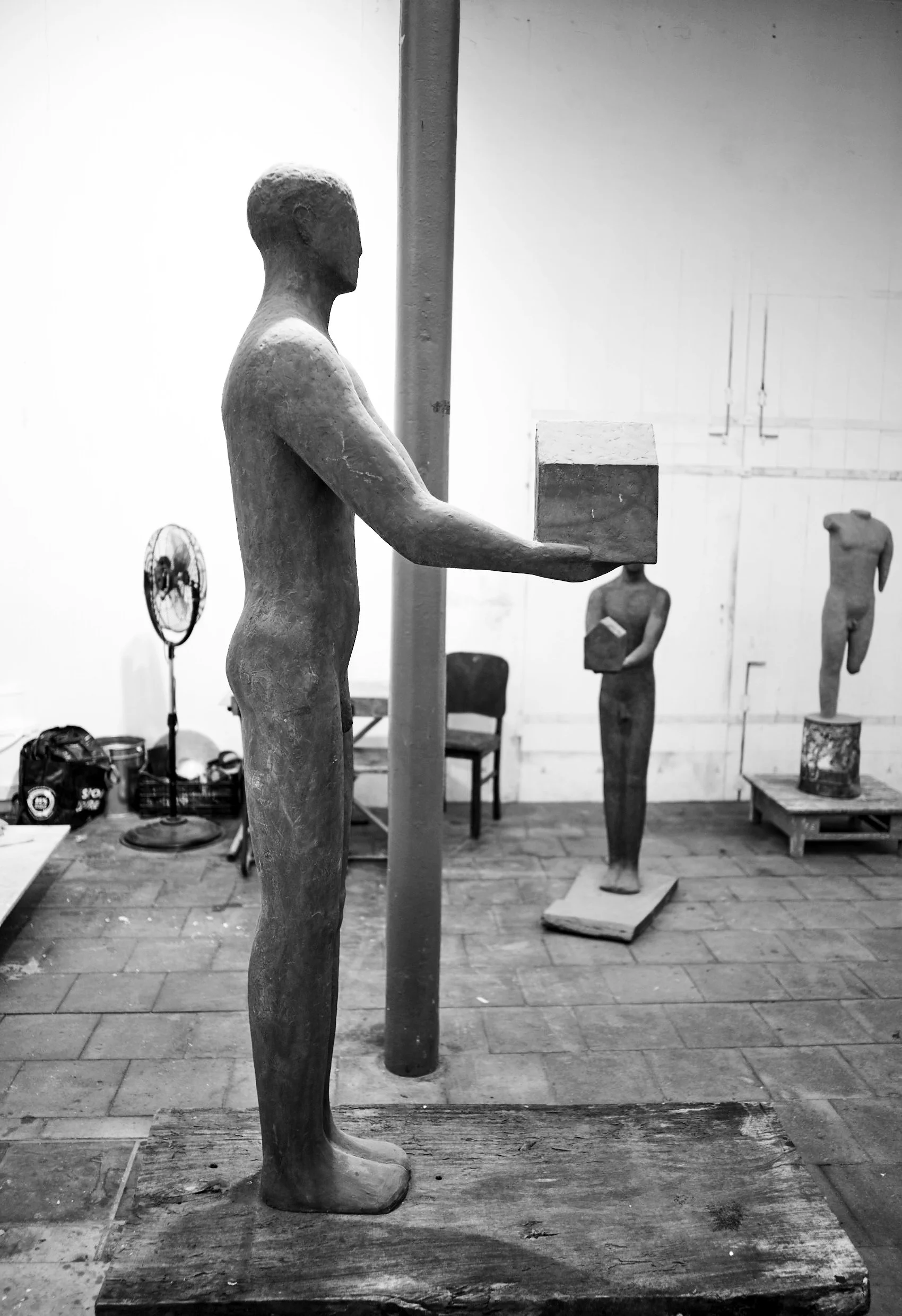
View of Philip Aguirre y Otegui’s studio in Antwerp. Photograph: Ram Shergill
“With simple yet highly effective forms, Aguirre communicates meaningful messages and encourages the observers of his sculptures to reflect on the human condition, society, and politics, including pressing issues relating to refugees and losing, finding, making and keeping a home. ”
“At the heart of the museum are people. A museum is much more than a place where you show art, it’s an emotional place and once you can touch emotions in people they learn more easily. ”
“Music was a very, very important theme in [Zadkine’s] career. You have, for instance, the gouaches such as Musiciens [Musicians, by his partner, the French painter Valentine Prax (1897–1981)], he also made The Great Orpheus [Le grand Orphée, 1956], which is also a music player. And he himself played accordion. ”
A Home for the People
The Royal Museum of Fine Arts Antwerp (KMSKA)
★★★★★
WRITTEN BY DAEN PALMA HUSE, 01.11.2026
PHOTOGRAPHY BY RAM SHERGILL
The Protagonist’s latest venture took us to Belgium. I interviewed the director of the Royal Museum of Fine Arts Antwerp (KMSKA: Koninklijk Museum voor Schone Kunsten Antwerpen), spoke to Belgian sculptor and artist Philip Aguirre y Otegui during a studio visit, and conversed with one of the museum’s longest-serving curators, Veronique van Passel. Our conversations revolved around the KMSKA as an institution and pertained to the two temporary exhibitions currently showing at the museum: Philip Aguirre y Otegui (03 October 2026 – 17 January 2027) and Ossip Zadkine and Belgium (31 October 2026 – 18 April 2027).
I approach the KMSKA in Antwerp from the city’s neatly kept and narrow streets. Upon arriving at the museum, a large permanent installation comes into view, covering the ground of the square in front of the KMSKA, with plant forms cast into a relief that mesmerises with its turquoise patina. Water ebbs in and out, representing the rhythm of time and tides – instead of shooting up as is usually expected with fountains. Deep Fountain (Diepe Fontein) was conceived by Cristina Iglesias in collaboration with the Belgian architecture firm Robbrecht and Daem in 1997 and installed in 2006. Today, no less than twenty years later, workers prepare the foundations for a plinth that will support a new sculpture on the side of the square: the work Petit Monument by Belgian sculptor and artist Philip Aguirre y Otegui (born 1961) will assume its permanent place here in December 2026.
Façade view of the KMSKA (Royal Museum of Fine Arts Antwerp) with Cristina Iglesias’ Deep Fountain (Diepe Fontein) on Leopold de Waelplaats, Antwerp. Photograph: Daen Palma Huse
Themes of migration and shelter are reflected in the artist’s work, and he regularly uses Spanish phrases or titles, including for his paintings. With simple yet highly effective forms, Aguirre communicates meaningful messages and encourages the observers of his sculptures to reflect on the human condition, society, and politics, including pressing issues relating to refugees and losing, finding, making and keeping a home. Aguirre’s father came from the Basque Country, and moved to Antwerp in 1936, when the Spanish Civil War started. Often, the artist uses found materials such as cans, canisters, barrels or a chair, and incorporates these into his sculptures. He also realised a monumental artistic and social project in Ndogpassi, a neighbourhood of Douala, Cameroon. I encounter the large-scale photograph of the Théâtre Source at the exhibition entrance – an amphitheatre built around a natural water source, serving as a daily gathering place and necessary water supply.
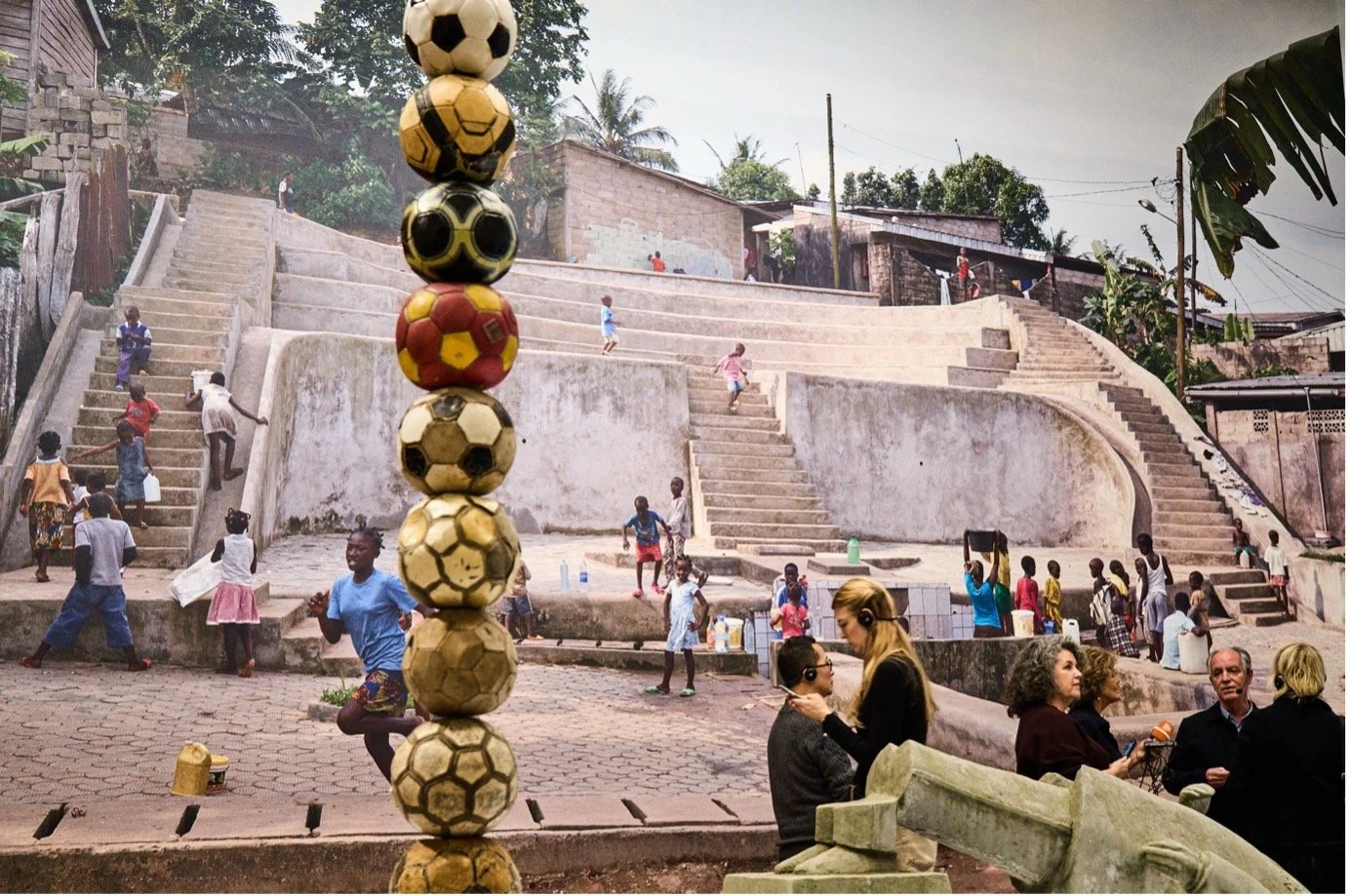
Exhibition view with wall print of Philip Aguirre y Otegui, Théâtre Source, Ndogpassi, Douala, Cameroon. In the foreground Tour du Monde, 2019, mixed media, collectie Roger Szmulewicz & Arpais Du Bois. Photograph: Ram Shergill
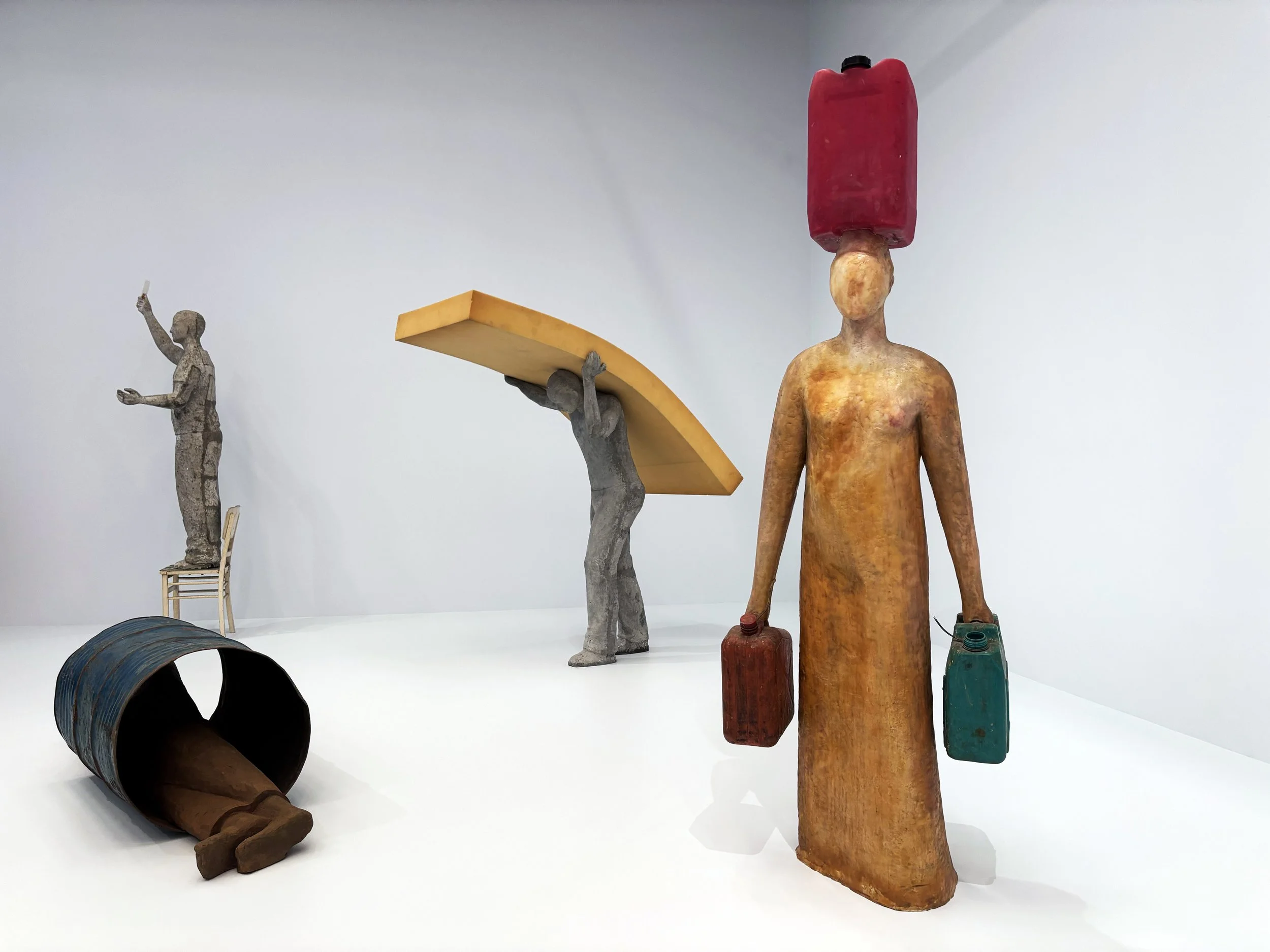
Exhibition view of works by Philip Aguirre y Otegui. From left to right: Refugio, 2022, iron and polyester, artist’s collection; Speaker’s Corner, 2001, cement, wooden chair and black and with photograph on paper, Mu.ZEE Oostende – Collectie Vlaamse Gemeenschap; Matrasdrager (Mattress Carrier), 2001, cement and foam rubber, Mu.ZEE Oostende – Collectie Vlaamse Gemeenschap; Waterdrager (Water Carrier), 1999, bronze, glass and rope, Universiteit Antwerpen. Photograph: Daen Palma Huse
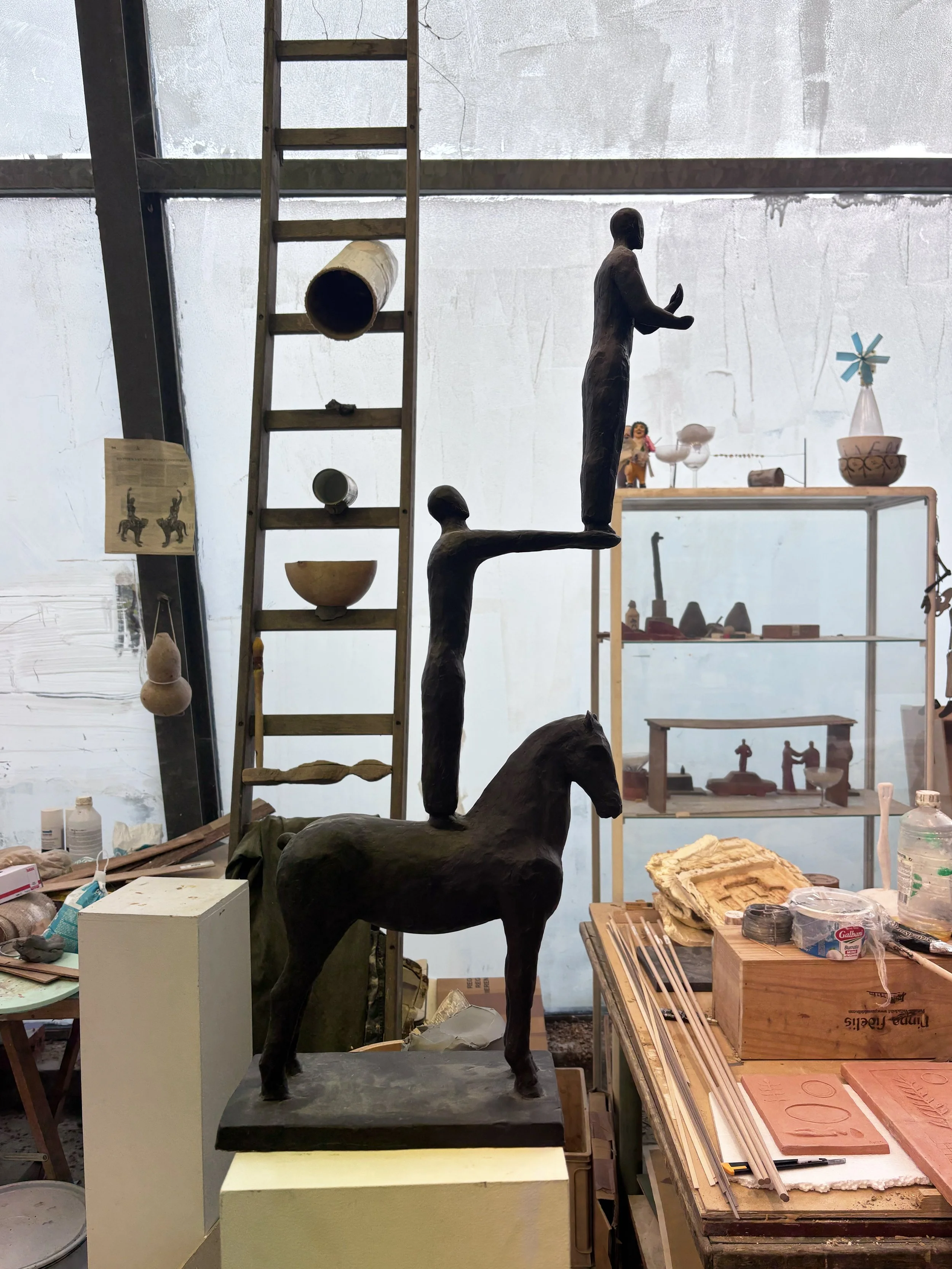
Study for Petit Monument (Small Monument), 2010, bronze, artist’s collection, at Philip Aguirre y Otegui’s studio in Antwerp. Photograph: Daen Palma Huse
When I spoke to Aguirre during a studio visit a day prior to visiting the museum, he explained that regardless of scale or medium, he aims to boil down larger concepts into simple forms that can be explored and connected with by the viewer – even without description. The exhibition at the KMSKA, curated by Annelien De Troij, features Aguirre’s works from across his career and includes textiles and paintings alongside his sculptures. Aguirre’s sculptures possess an ephemeral quality when seen from different angles; just a moment, a minute movement, and the sculpture’s shape presents itself differently from the previous moment of observation. De Troij and Aguirre have worked together closely to create a space that allows for an immersive and contemplative experience. The works become part of the spaces they live in, temporarily or permanently, interacting with existing architectural structures and drawing connections between people. In an everlasting exploration of its form, I immerse myself in viewing maquettes of Petit Monument during a visit to the artist’s Antwerp studio in an up-and-coming area of the city, where Aguirre has worked and lived for over twenty years now. The sculpture represents a horse with a human figure standing on its back, who, in turn, is holding another figure in the air at arm’s length. This second figure could be seen as beckoning someone in the distance, hands gently gesturing. The piece intrigues me through its representation of a seemingly impossible act of physical strength and fortitude between the two figures and strikes me through its interplay between structural strength and softness of gesture as a balancing act.
The small building site on the square in front of the KMSKA that I spotted earlier, and the sculpture that is to complete the space, send an important message: this museum never stands still; it evolves in its dynamic state – as confirmed by my own experiences once I entered the museum. The artist whose work will be revealed later this year on the square is Philip Aguirre y Otegui. He is local to Antwerp and has enjoyed an international career, now culminating in a solo show at the KMSKA (Philip Aguirre y Otegui, 03 October 2026 – 17 January 2027). He reveals to me that he is extremely proud to show at the museum, particularly because local people he knows can come and visit the show, which has, in fact, included his barber. The director of the KMSKA, Carmen Willems, tells The Protagonist Magazine that the museum’s local connections provide the foundations on which it has gained international recognition. “We want to have big names of international resonance, but we also dare to include names that might be lesser known internationally. We hope that this mix can surprise international audiences.” Aguirre straddles both spheres: he is internationally known but is at home in Antwerp.
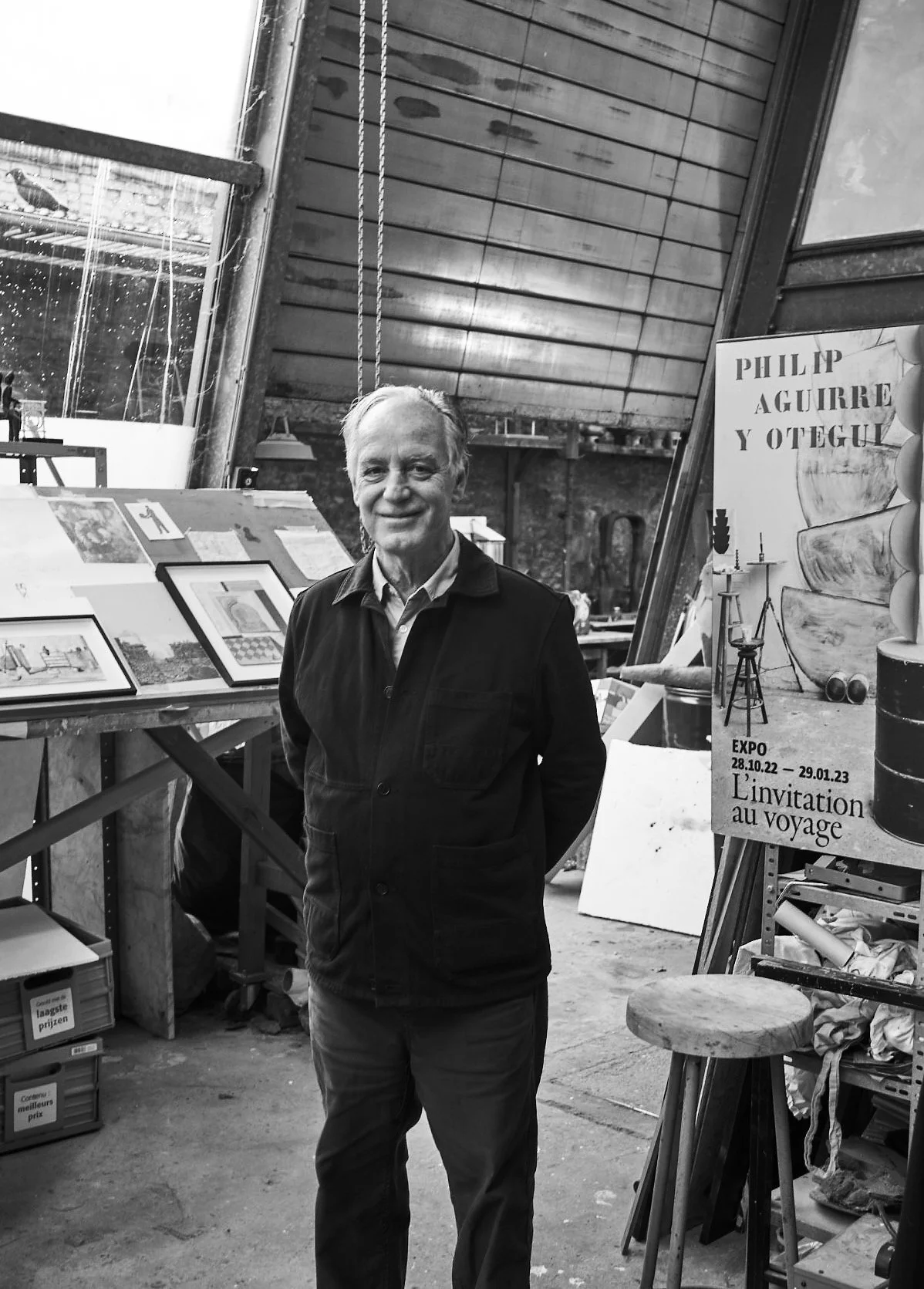
Philip Aguirre y Otegui in his Antwerp studio. Photograph: Ram Shergill
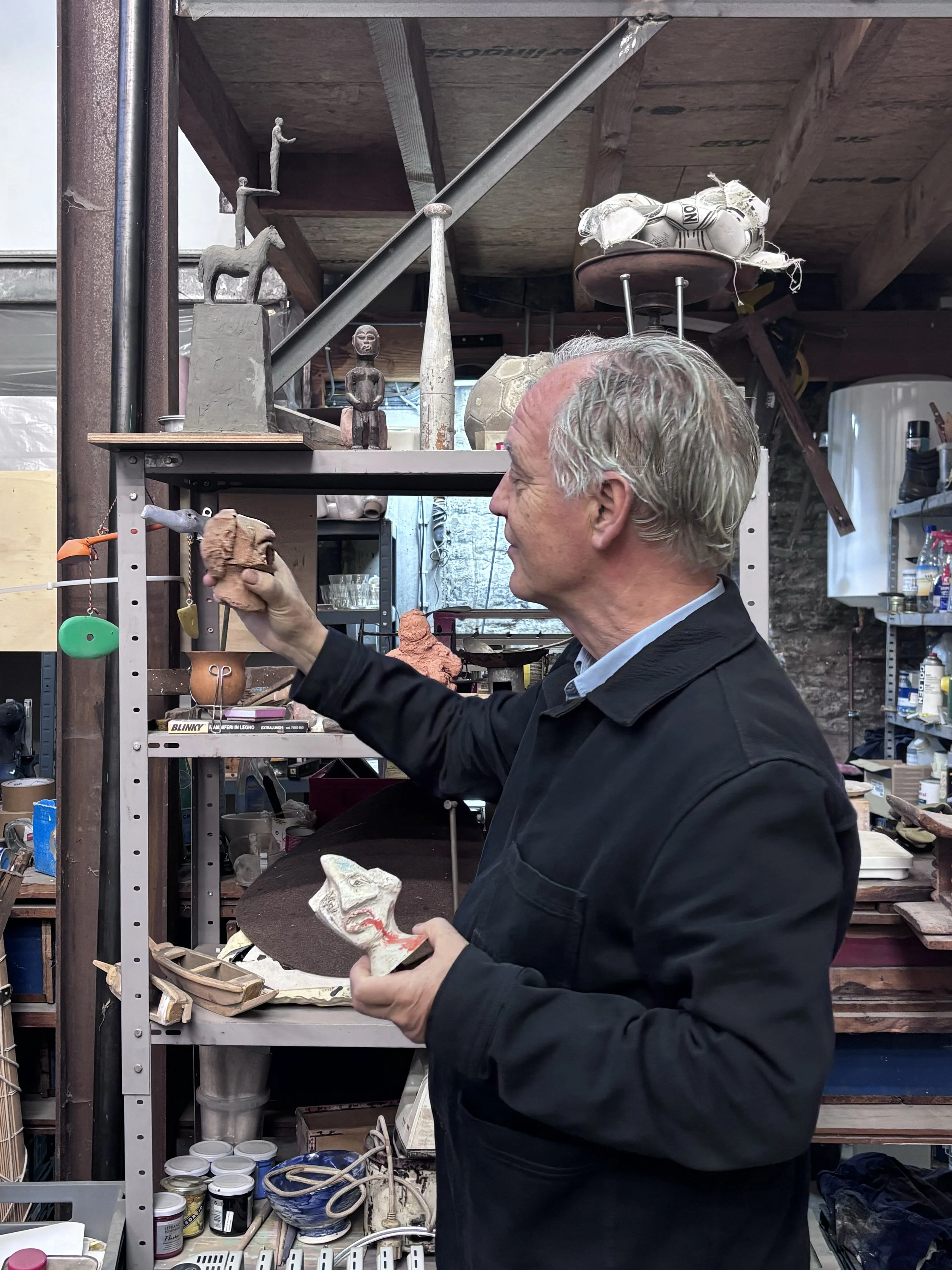
Philip Aguirre y Otegui at his Antwerp studio, holding and remembering two of his early small-scale sculptures that he worked on at art school. A maquette of his work Petit Monument can be seen on the shelf in the background. Photograph: Daen Palma Huse
Having joined the museum in 2017, Willems oversaw a large-scale restoration and extension project of the museum before its reopening in 2022. As an economist, Willems combines her love for art with her love of people. “I’ve always wanted to be on that cross-section of culture and economics. I wanted to study art history, but my parents thought it would not give me lots of chances in my career. Then I thought I want to know how the world is organised – and economics usually tells you a lot about this – and still I wanted to go into the cultural world.” As a child and younger adult, Willems loved going to performing arts events and installations. Starting in 1993 during Antwerp’s celebrations as European Capital of Culture, she experienced the city more closely for the first time, before returning to her hometown Tongeren, which has origins in the Roman administrative capital Atuatuca Tungrorum and is the oldest town in Belgium. There, she acted as the director of the Gallo-Roman Museum, elevating the institution to an internationally recognised museum, with the eventual desire to move on to bigger ventures. Willems tells me that it is very important to be sensitive to the city where one is located and highlights the engagement with the local public as a key to success. “At the heart of the museum are people. A museum is much more than a place where you show art, it’s an emotional place and once you can touch emotions in people they learn more easily. There are a lot of museum professionals that view museums as learning machines. I am not saying they aren’t, but in the first place you should feel at home, and then you can learn. I like that people come out and are inspired by what they see – but it doesn’t have to be all about data and knowledge, it can also be a feeling, a feeling that can give you another way of thinking in your personal life, inspire more creativity – simply to have the feeling that it opened your mind… these are all important things when you visit a museum.” Two of Aguirre’s works, Casa para el Mundo (House for the World) and Se vende productos inútiles (Useless products sold here), which I discovered in the exhibition catalogue and Aguirre’s studio respectively, resonate with Willems’ approach. The former speaks to notions of home, providing a home for the world – a space where everyone is welcome – while the latter questions notions of purpose; value is not always measured in numbers or in usefulness. Positive emotions are priceless; value cannot always be measured and translated into facts and figures.
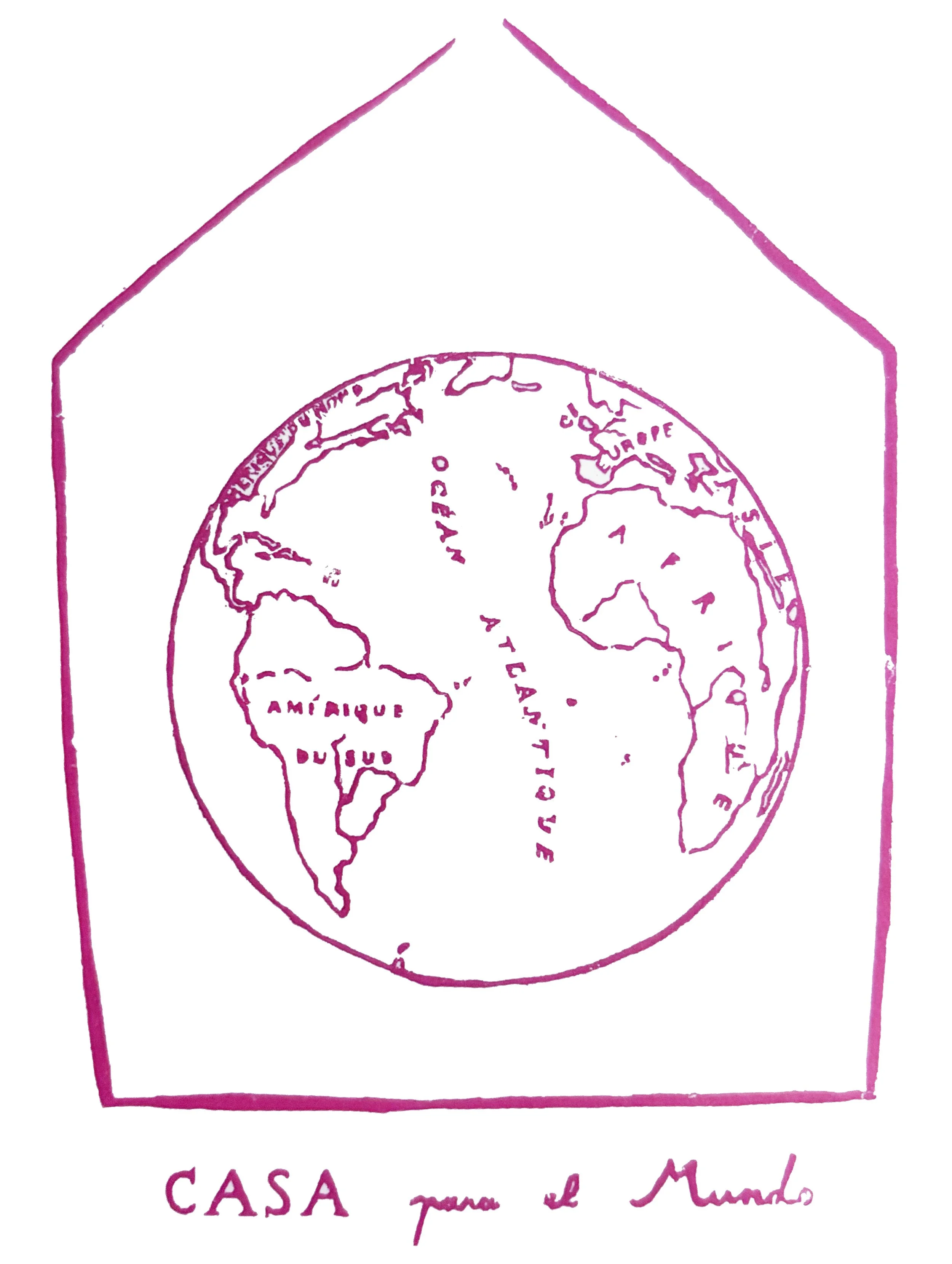
Casa para el Mundo (Home for the World), 2014/2017, wood engraving on paper, Mu.ZEE Oostende – Collectie Vlaamse Gemeenschap.
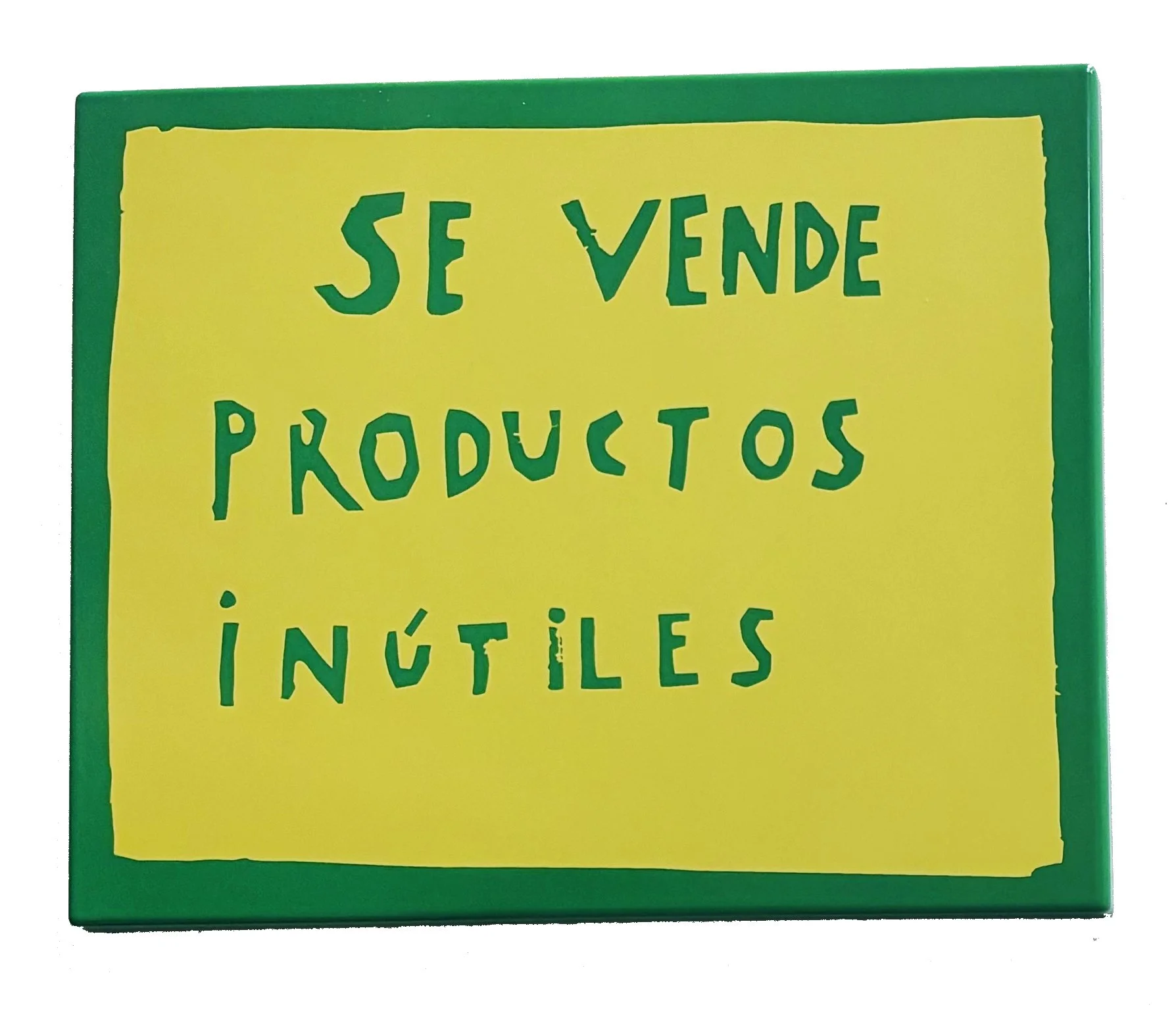
Se vende productos inútiles (For Sale Useless Products), 2010, woodcut on paper, 31 x 46 cm, artist’s collection.
Next to Aguirre’s exhibition, which follows a large retrospective of Antony Gormley’s work, the KMSKA now also features Russian-French sculptor Ossip Zadkine (1888-1967) in a second temporary show. Zadkine’s influence and inspiration can be observed in Aguirre’s work, making the two exhibitions a complementary pair. Ossip Zadkine and Belgium (31 October 2026 – 18 April 2027) was carefully curated by Veronique van Passel. She highlights Zadkine’s close connection to Belgium, especially during the earlier years of his career. Based on new archival research, she has successfully reunited pieces from private and public collections, some of which were previously exhibited together during the artist’s lifetime, for the first time in decades. The exhibition contains a large body of works, including correspondence and artworks that contextualise Zadkine amongst his contemporaries. I discover a pencil portrait of Zadkine by Amedeo Modigliani (1884-1920) and a gouache by Marc Chagall (1887-1985) – a work that even surprised Willems during our joint exhibition visit. She spotted the artwork, which depicts a woman at a window looking out onto the night sky, and upon closer inspection realised that it is part of the KMSKA’s own collection.
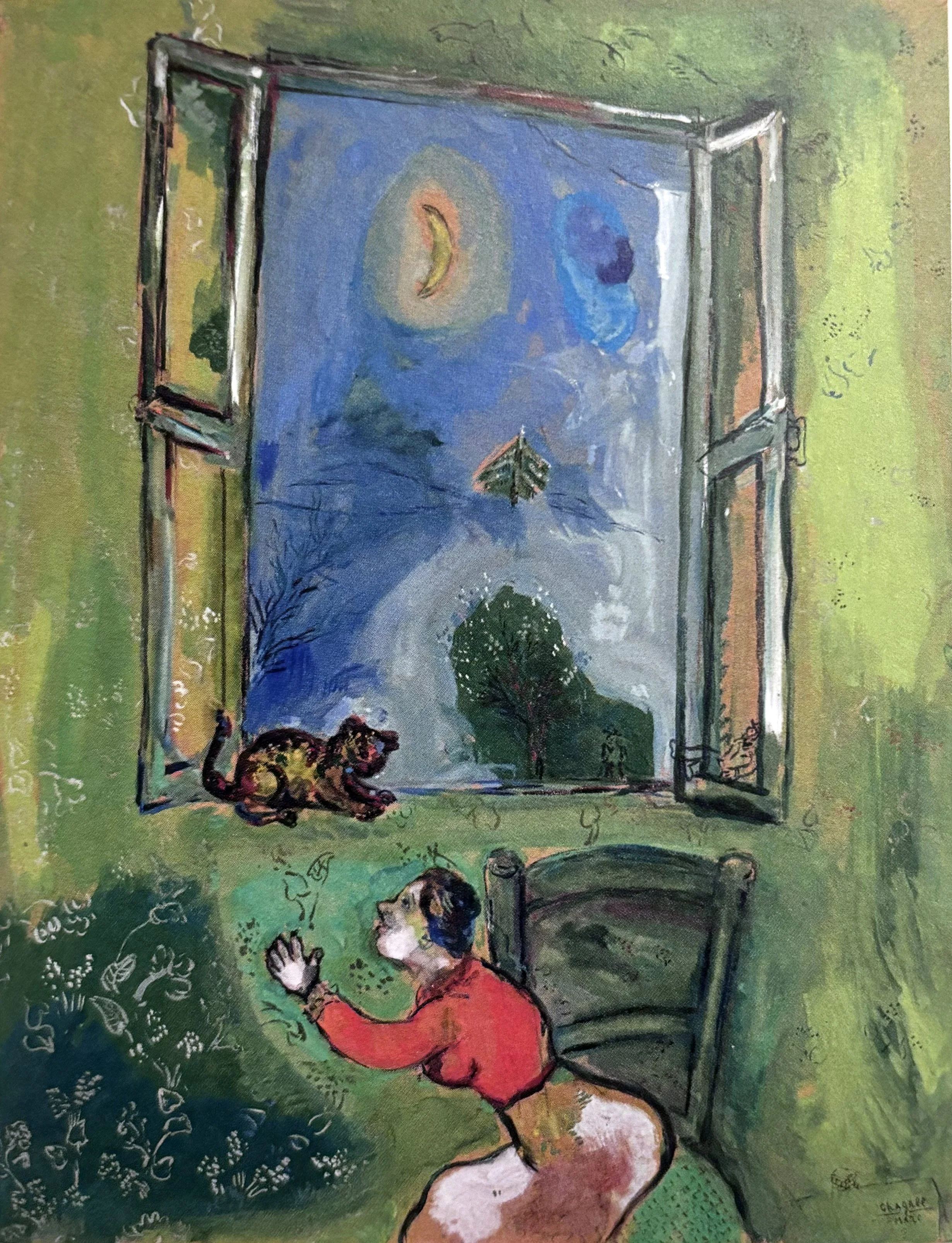
Marc Chagall, At the Window, 1927-28, gouache on paper, 666 x 510 mm, Royal Museum of Fine Arts Antwerp – Flemish Community Collection
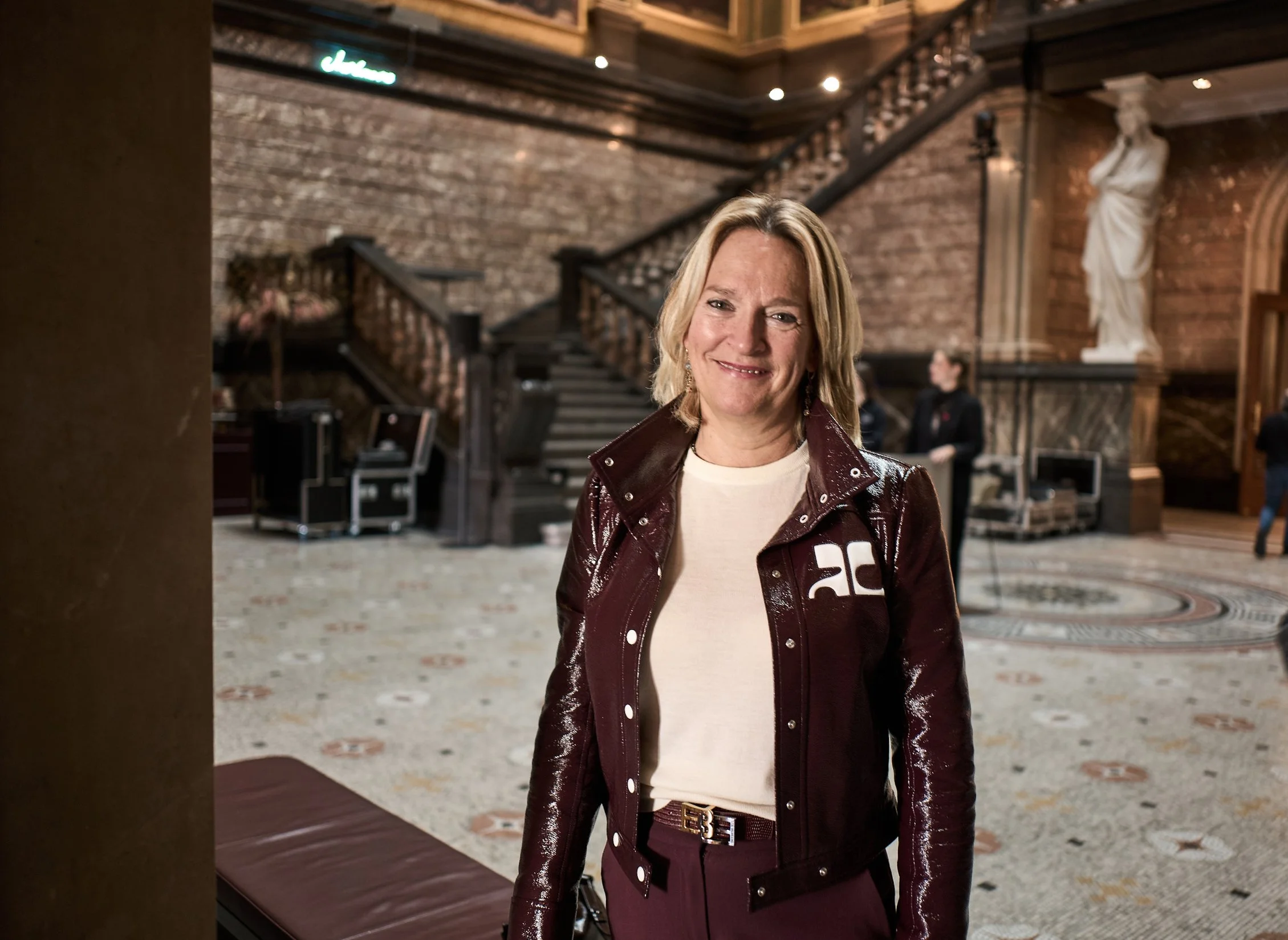
Carmen Willems, portrait by Ram Shergill, 2026.
With over eight thousand objects, the KMSKA’s collection holds surprises even for the museum’s director. Willems stresses that she hopes visitors will return, regulars and newbies alike, to keep exploring the collection each time they visit because it is impossible to know all of these objects, each with its very own story. Museumgoers can explore the permanent and temporary exhibitions throughout the old building, which opened to the public in 1890, and its ambitious new extension which was created in the building’s former inner courtyards between 2011 and 2022. Willems explains that the museum “expanded inwards.” Retaining its historic appearance on the outside, the space unfolds like an eccentric jewellery box, open to everyone.
The old exhibition rooms featuring large-scale works by well-known Flemish painters such as Peter Paul Rubens (1577-1640), Jan van Eyck (1390-1441), Anthony van Dyck (1599-1641), and Jacob Jordaens (1593-1678) are by no means static: they are interspersed with contemporary artworks and special displays such as the recent KMSKA X YONG FASHION DESIGNERS (4 June 2026 – 8 November 2026), alongside activity stations for children and adults alike, which blend seamlessly into the exhibition spaces, and public programming. I am particularly intrigued by an initiative that involves blind people: Willems recalls one of the museum’s collaborators losing their sight during the museum’s long closure for renovation and wanting to involve them. Now visitors can engage with one of the four “blind guides” who currently work with the KMSKA and focus on one object in a dedicated space, observing and describing. For many young visitors, according to Willems, their encounter with the blind guides is often their first of its kind: “Blind people can listen very well, dedicated to listen, catching up feelings and it is so much more than describing an object, it is about emotion. For children it often is the first time they talk to someone blind, asking ‘Do you really not see anything? How do you put your shoes on?’ It’s not only about art, but about human experience. Visitors are surprised and say, ‘It was so nice to talk to someone that slowed down my visit!’”
The main staircase of the museum features a concert piano that invites visitors to play. Music has played an important part in Willems’ personal life. She started playing the violin and learned the piano after proving her dedication to music to her parents: “I could hire a violin and it was less complicated so I started, and after a while my parents thought I was working really hard on that so we decided to buy a piano.” The multisensory exploration of the museum is further encouraged through special collaborations such as the recreation of musical instruments and a composition to imagine the soundscape of a painting, and the museum’s Thursday Late programme that includes regular concerts and performances. In the exhibition about Zadkine, I discover music in several artworks. Inspired through all the senses, I imagine the sounds of the instruments that Zadkine included in his figures coming alive, at the same time as reminiscing about the sound of the tools a sculptor uses when creating a new work in their studio, mixing with dust and the vibration of chiselling and shaping its material.
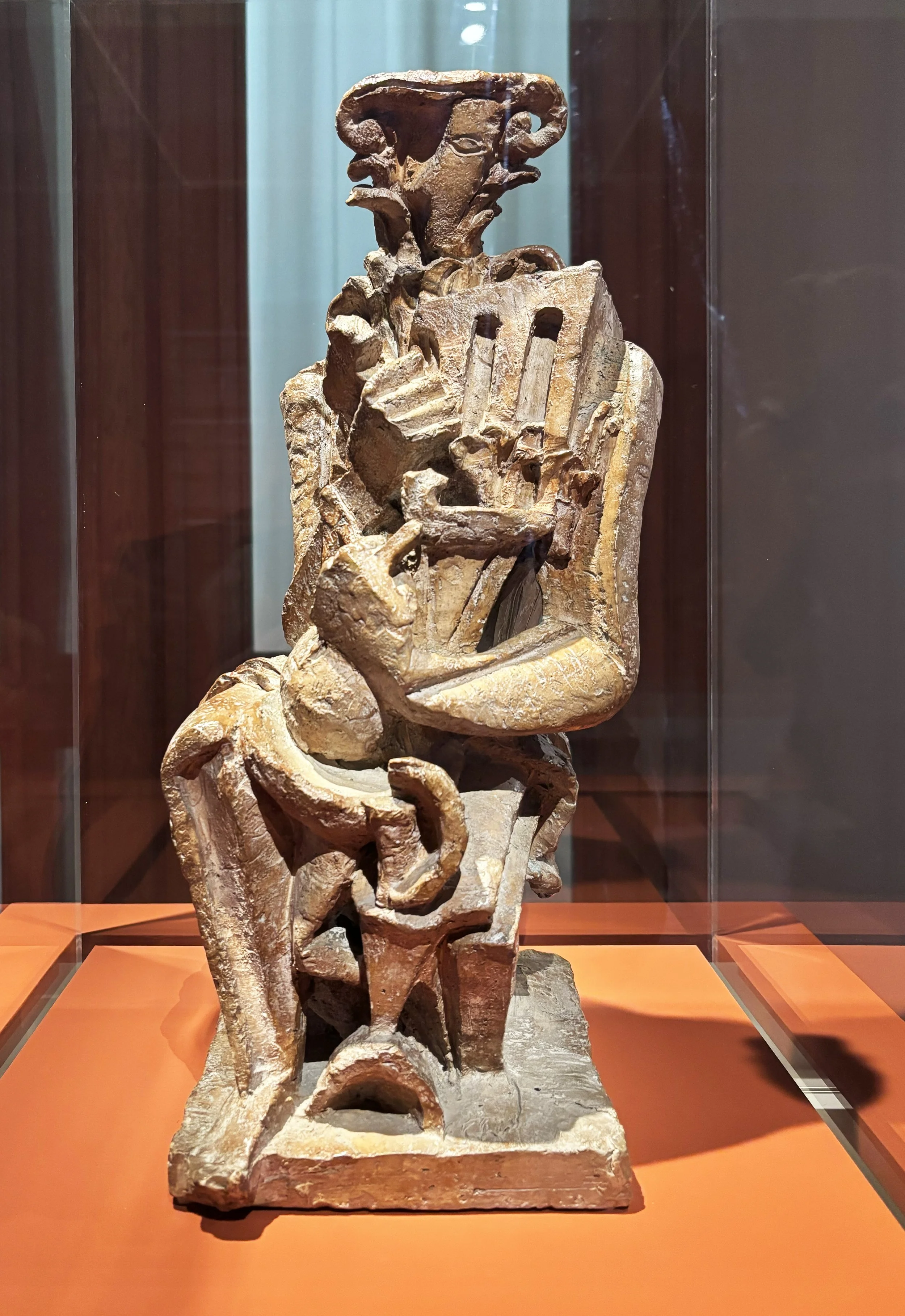
Ossip Zadkine, Le sculpteur (The Sculptor), 1941, terracotta, seen in exhibition view, private collection Brussels.
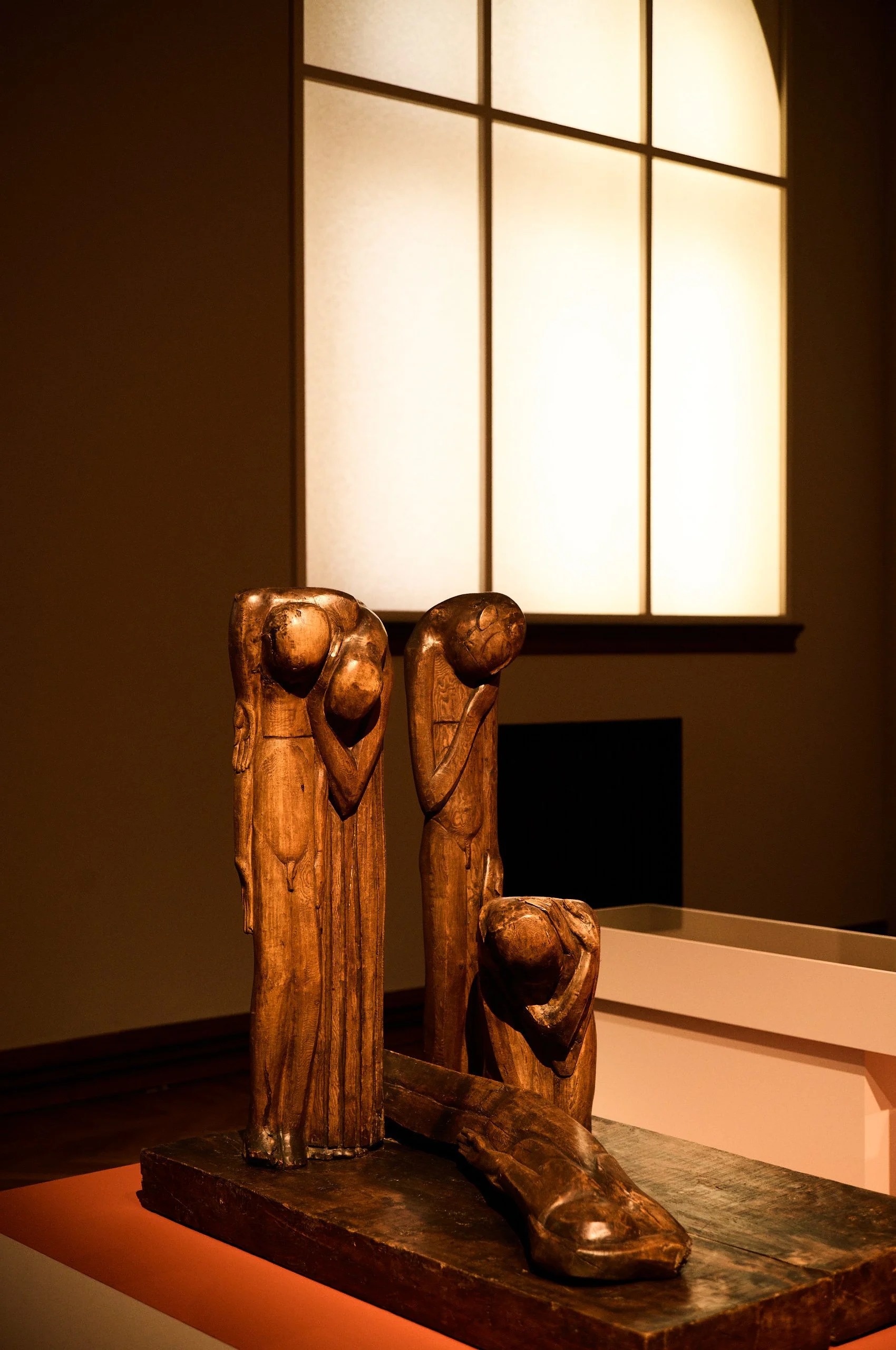
Exhibition view with Ossip Zadkine’s Job and His Friends, 1913-1914, elmwood, Royal Museum of Fine Arts Antwerp.
When I mention my observation about musical instruments in the exhibition to curator van Passel, she enlightens me about Zadkine’s own knowledge of playing the accordion and the role of music in his work: “Music was a very, very important theme in his career. You have, for instance, the gouaches such as Musiciens [Musicians, by his partner, the French painter Valentine Prax (1897–1981)], he [Zadkine] also made The Great Orpheus [Le grand Orphée, 1956], which is also a music player. And he himself played accordion. You see one of them in the exhibition. What we knew was that this sculpture, a wooden sculpture, was bought in the 1920s by a Brussels lady, but from that moment on it was completely lost. Two years ago, our museum had the opportunity to take a collection of modern artists, about 30 pieces, on permanent loan. My colleague went to see this collection and sent me a picture and said, ‘I think we have Zadkine, perhaps it is interesting for the exhibition?’ and I went ‘Oh my god, this is the Accordionist [Accordéoniste] that we have lost trace of since the 1920s, for one hundred years!’”
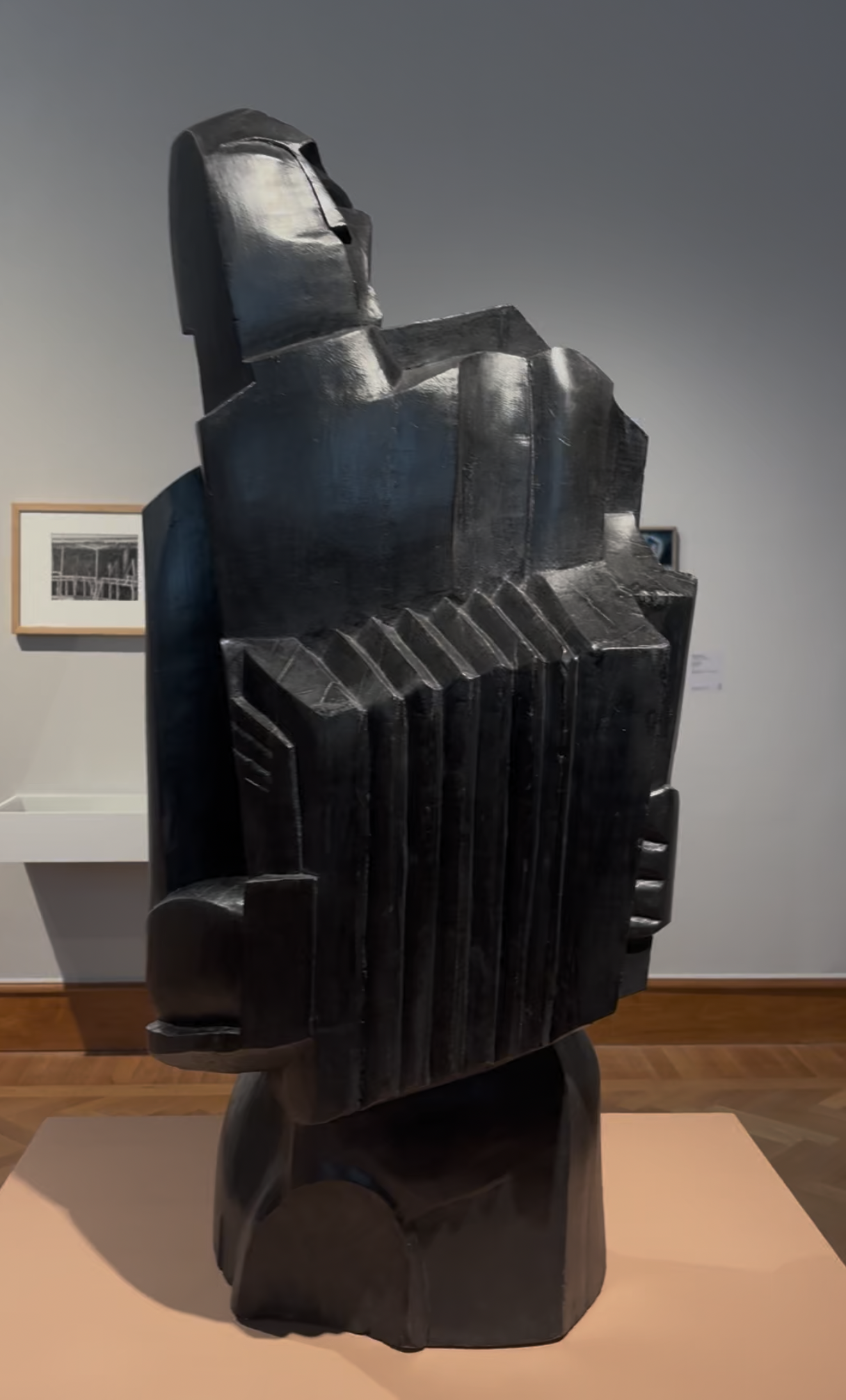
Ossip Zadkine, Accordéoniste (Accordionist), 1924, wood, not yet painted, 108 × 48 × 38 cm, seen in exhibition view, formerly in the Pechère collection, long-term loan to the Royal Museum of Fine Arts Antwerp.
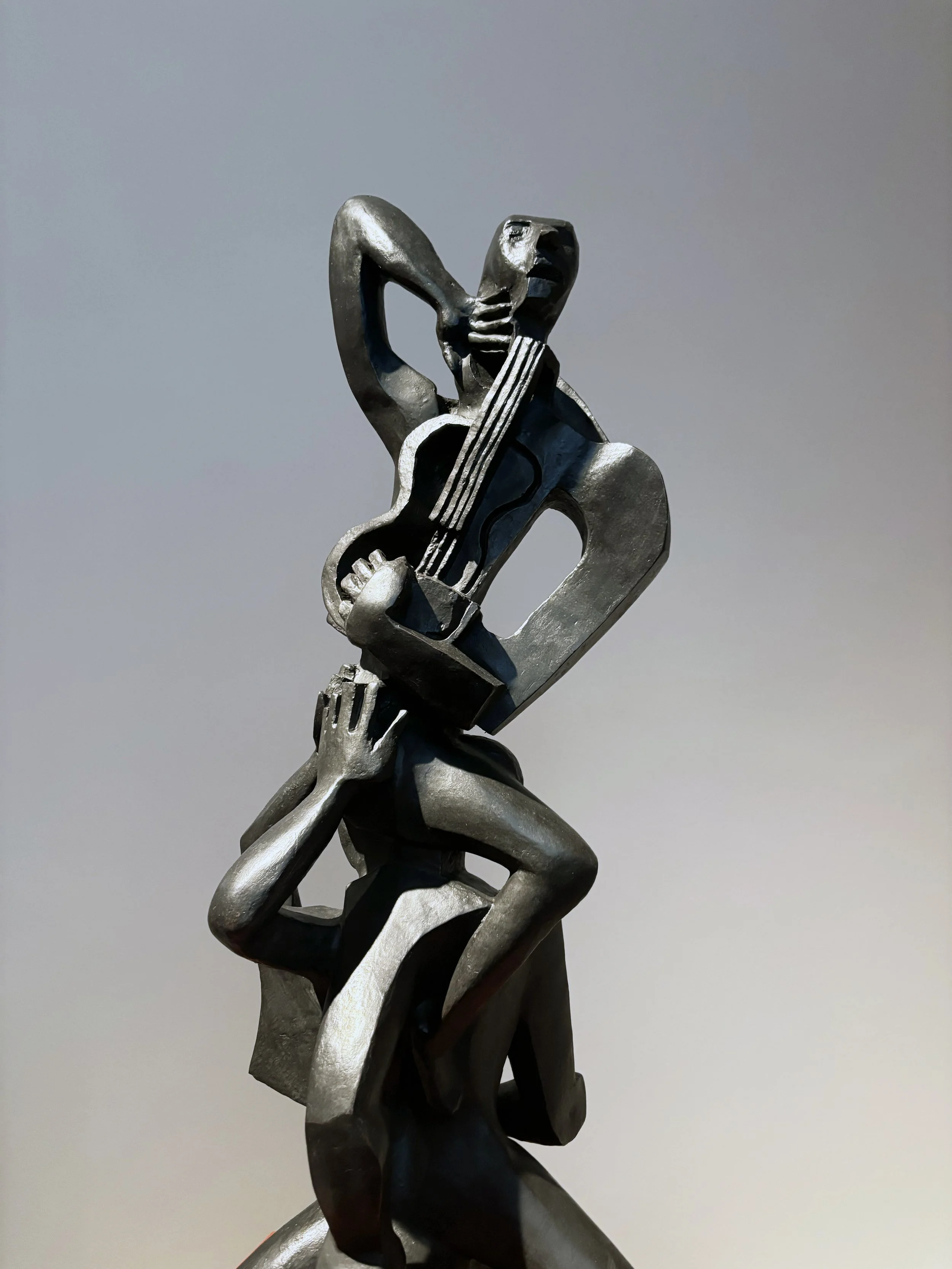
Ossip Zadkine, Les acrobats (The Acrobats) (detail), 1943, cast Susse 1962 1/6, bronze, seen in exhibition view, Paris Musées/Museé Zadkine.
Director Willems stresses that the current exhibition on Zadkine is part of the museum’s dynamic programme that provides unique new perspectives. Through the exhibition’s focus on the sculptor’s connection to Belgium, it imbues the Belgian public with pride when reading Zadkine’s quotes on the exhibition walls that compliment Belgian tastes and the Belgian public’s appreciation for his art in the early stages of his career: “Belgians were my first admirers.” The show’s curator, van Passel, has unearthed and newly identified exhibition views that so far remained hidden away in archives, sometimes without clear attribution. The exhibition space allows the visitor to learn about Zadkine’s artistic and social circles, including his long-term primary partner, Valentine Prax. As the curator’s last big show for now, Willems praises the quality of van Passel’s work and reassures me that former curators frequently continue to be involved with and return to the museum.
The museum’s team is not averse to taking risks. It offers an exhibition programme that concentrates on sculpture this year, a medium which is often less popular with the public, and regularly includes artists who may be lesser known on the international stage, but who hold the potential to surprise visitors. The museum’s visitor numbers tell a story of success. Willems expresses her joy about the interest that the public has shown in the museum over the past years. A large part of the museum’s popularity results not only from its unrivalled Flemish collection and its impressive holdings of works by Belgian painter James Ensor (1860-1949), but also from its collaborative process in developing its ever-changing exhibition programme that is sensitive to its world-class collection of Old Masters and invites contemporary exhibitions. Willems stresses that it is not just the curators that conceive an exhibition, then hand the concept to marketing to reach people. Instead, this process is approached collaboratively, involving experts, including those in education and marketing, assuming force in joined expertise.
The KMSKA is an international melting pot, uniting a diverse range of objects, artists, and visitors, under its newly renovated roof. Willems is passionate about involving a diverse range of audiences and surprises me with a refreshing perspective on museum politics and on uniting the museum’s traditional role as a knowledge institution with a dynamism that recognises its people. “The fun factor in the museum is very important – if the visitors had fun and connected with each other through conversation starters that are hidden throughout the museum, they will come back.” Willems tells me that Antwerp is home to a large Moroccan community. The museum observed that many of these local community members chose the museum as a location for their wedding photographs. The KMSKA’s innovative reaction was to start offering free entry to the couples. “They choose us as their place to come in such an important moment in their life. You will almost see it every day. We like it! On the condition they will come back, we say, we open our doors.” When I strolled through the exhibition spaces, I did indeed discover one such couple in the galleries.
With regards to future generations, I asked Willems what she would want her children to learn from her. She tells me: “Hopefully they will explore art, and art will be an important thing in their lives because for myself, my emotions, I feel like art helps me to have a creative and good life. I hope they will find that in art but if they find that in sports, for example – then that is great too. What I hope is that my children and grandchildren grow up as good people that have respect for each other and a good heart. If they talk to their friends I hope they say my mother is ambitious, she works hard and also has a big heart. For the museum, I like to give heart also. It is like a big family. The reopening was hard work, but we all made it together, as a team. The people that work here have such adoration for the collection; it’s a pleasure to work with them.”
The KMSKA sets an example for museum spaces that are inviting and inclusive, in Belgium and beyond. Its participatory and responsive character makes the museum both welcoming and approachable, without seeming to try too hard. Exiting the museum, I feel like I am leaving a newly found home, a home for the people that lives through its visitors and that has brought its world-class collection closer to me even after one visit. Antwerp is easily reachable by train from London, Paris and Cologne, making it an ideal destination. I am inspired to return.
Philip Aguirre y Otegui is showing at the KMSKA from 03 October 2026 to 17 January 2027.
Ossip Zadkine and Belgium is showing at the KMSKA from 31 October 2026 to 18 April 2027.