
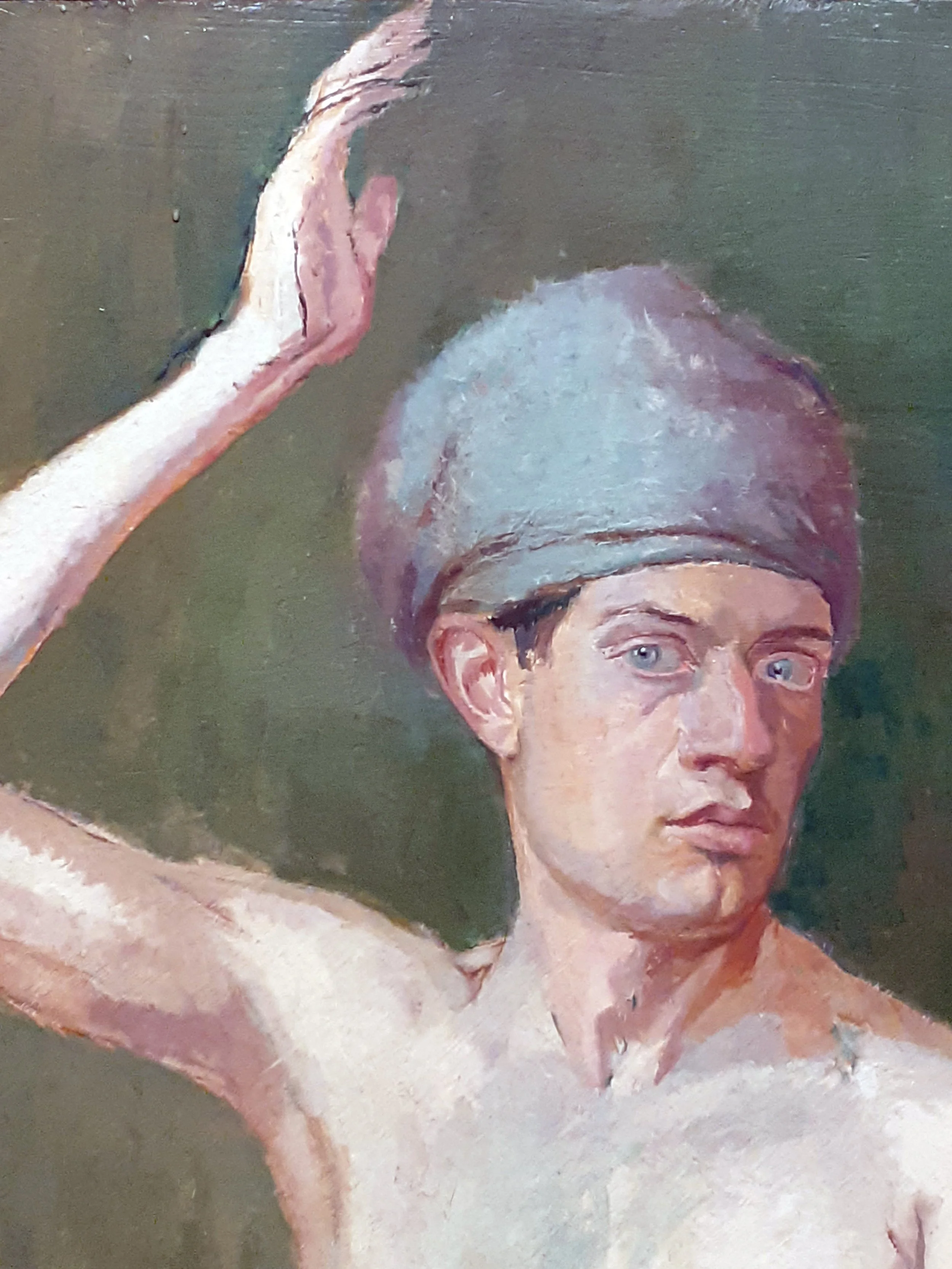
Duncan Grant, “Study for Composition: Self-Portrait with a Turban” (1910). Photograph: Birgitta Huse
“With this exhibition, art and (future) Bloomsbury Group aficionados delve into a bold, seemingly fright-less and colourful world of art, design, literature, travelling, group belonging, and the Bloomsbury Group’s legendary “love in triangles” as some of its core ingredients”
A Bloomsbury Home Story
“Vanessa Bell & Duncan Grant. Inside Bloomsbury” at Tate Britain
★★★★★
WRITTEN BY DR. BIRGITTA HUSE, 18.11.2026
Duncan Grant looks at us directly with his blue eyes. His bare-chested body stands out before a green background. The upper part of his head is wrapped in a light blue textile in a turban-like style. Most striking is the unusual and artistic pose with which the artist presents himself in this self-portrait: He lifts one arm, building near ninety-degree angles with it. The way he holds his hand reminds me of an Indian temple dance posture. The painting sets the tone and the mood for what is to follow in the exhibition – the presentation of alternative art and an experimental lifestyle that challenged existing societal conventions at the time. The Bloomsbury Group, of which Grant was a member, strongly appeals to us until today. Its members are the protagonists in an early twentieth-century story that one could draw (practical) inspiration from – and who doesn’t like escaping one’s everyday now and then?
Tate Britain announces the show, which is curated by Thomas Kennedy (Curator, Modern British Art) and Eliza Spindel (Assistant curator, Modern British Art, both Tate Britain), as including more than three hundred works. Paintings range from “early post-impressionist and abstract paintings to late naturalistic self-portraits, landscapes and still lifes.” Vanessa Bell’s (1879 – 1961) and Duncan Grant’s (1885 – 1978) approximately five-decade long and complex (working) relationship and their unconventional approach to life as members of the Bloomsbury Group is presented to the public in a way that strongly reminds of a home story which reveals private stories to magazine readers. Visitors “read” a personal narrative in which the protagonists’ perspectives are communicated not only via their paintings and drawings but also revealed through their letters. Explanatory texts build an almost amicable relationship between reader and artist by talking about Duncan and Vanessa, using their first names instead of Duncan Grant and Vanessa Bell.
Exhibition visitors follow Bell’s and Grant’s life from their first introduction to each other in 1906 and Bell’s tea invitation letter written to Grant in 1909 to their settlement at Charleston House in the Sussex Downs in 1916 and onwards into the early 1940s. Wandering through the exhibition rooms comes with a feeling of visiting an exclusive, extraordinary and stylish home, and getting more or less private insights into the owners’ lives. Paintings and photos depict Bloomsbury Group members in action or resting on chairs; books, letters and other ephemera, such as a menu, serve as proofs of a vivid intellectual exchange and conviviality within the group; furniture, fans, jars, rugs and a gown allow exhibitiongoers to experience objects the artists surrounded themselves with directly. The “Famous Women Dinner Service” (1932-4) was created by Bell and Grant for art historian Kenneth Clark. It is part of this display of objects. The service consists of fifty ceramic Wedgwood dinnerplates with hand-painted portraits of women like Mary Queen of Scots, Native American celebrity Pocahontas, Greta Garbo and Japanese author Murasaki (Shikibu). During my visit I felt some awe in the air as I witnessed people linger for longer than usual in what seemed to be an intense communication with a certain piece and its story – sometimes with a smile of knowledgeable recognition.
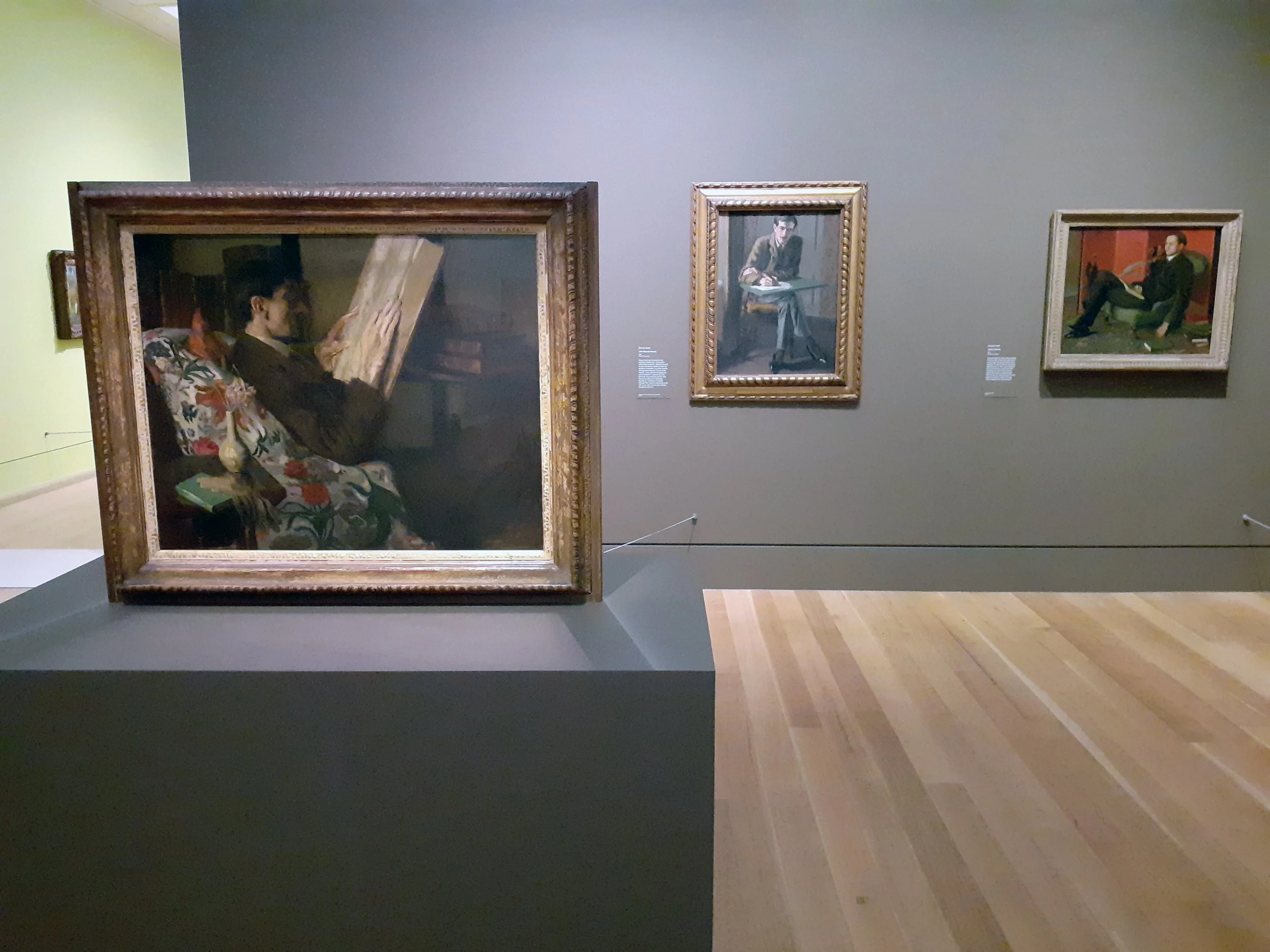
Exhibition view. Photograph: Birgitta Huse
With this exhibition, art and (future) Bloomsbury Group aficionados delve into a bold, seemingly fright-less and colourful world of art, design, literature, travelling, group belonging, and the Bloomsbury Group’s legendary “love in triangles” as some of its core ingredients. An uncompromising experimental approach and an intense exchange of unconventional ideas was key for the circle of these London artists whose nest was long located at 46 Gordon Square in Bloomsbury.
Bell created her own “outlet” in 1905, years before her works were shown alongside Henri Matisse, Pablo Picasso and Paul Gaugin in 1912 in the Second Post-Impressionist Exhibition at the Grafton Galleries in London. She founded the Friday Club, a society for exhibitions, lectures and discussions about art, where she exhibited her early paintings.
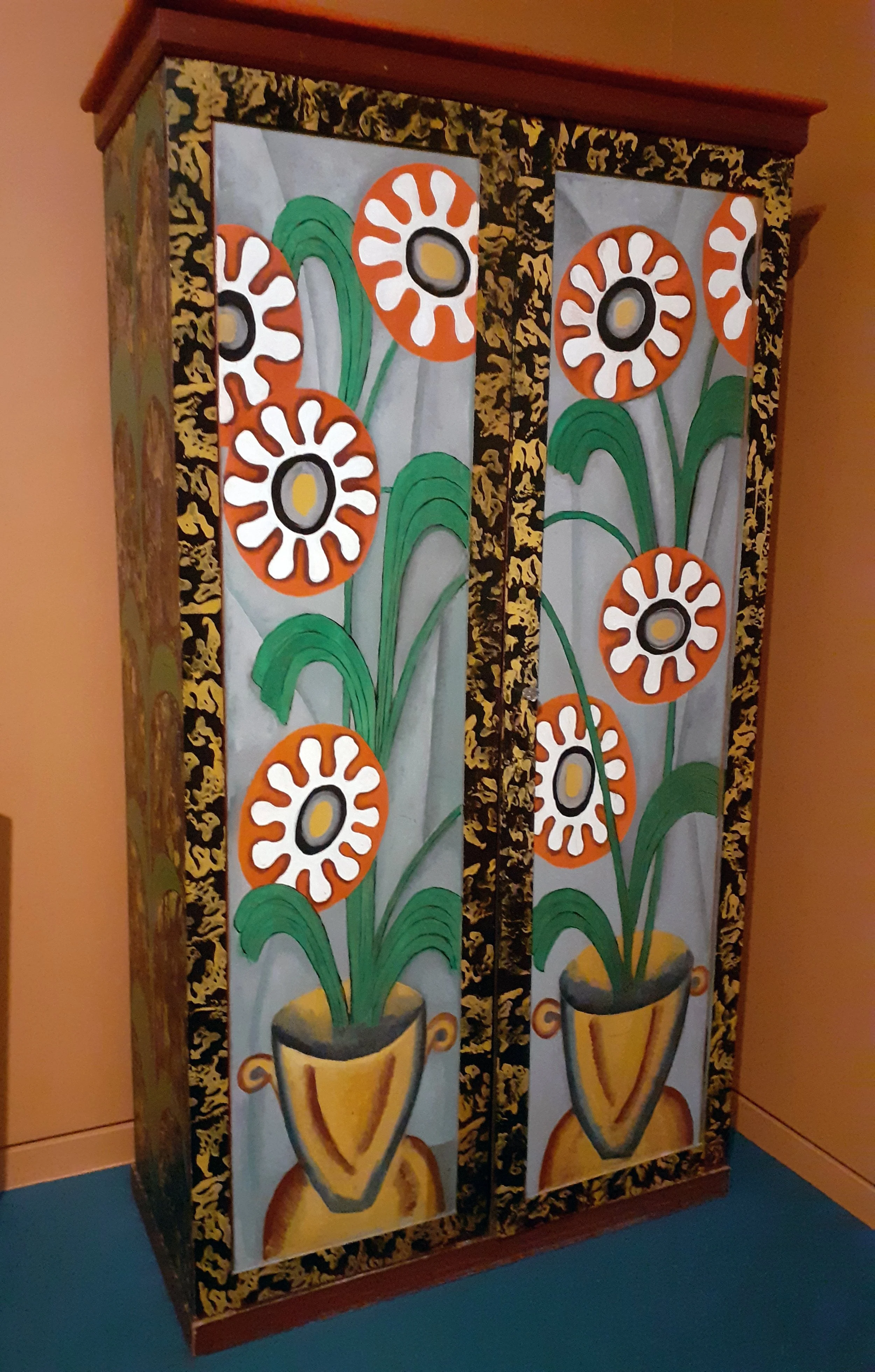
Omega Workshop, Roger Fry, wardrobe for Lalla Vandervelde, (1915-16). Photograph: Birgitta Huse
Bell and Grant joined the Omega Workshops, which was founded by Bloomsbury Group artist Roger Fry, in 1913 and acted as co-directors creating designs. Omegas’ furniture, vases, rugs, wallpaper, candlesticks, cushions, pieces of clothing and more brought the avant-garde painting into homes. The Workshops’ creations were far from matching the general taste of the time. A picture story in the Daily Mirror, which was published in 1913, demonstrates this. The story that is titled “A post-impressionist flat: What would the landlord think?” questions the reader if they would like to have their home fitted with post-impressionist furniture, carpets and hangings. It continues to comment critically underneath a photo that this would be the kind of room the reader would live in “if your nerves could stand it.” The publication refers to people who rent rather than own property and strongly suggests that a landlord’s thoughts about a renters’ furniture would matter.
The unusual number of letters, photos, postcards and other ephemera on display not only reveals the vivid exchange within the group but also allows informative glimpses into relationships between individual group members with one another. Some of Virginia Woolf’s books on display demonstrate Woolf’s sister Vanessa Bell’s involvement in dust jacket design and illustrations that these include.
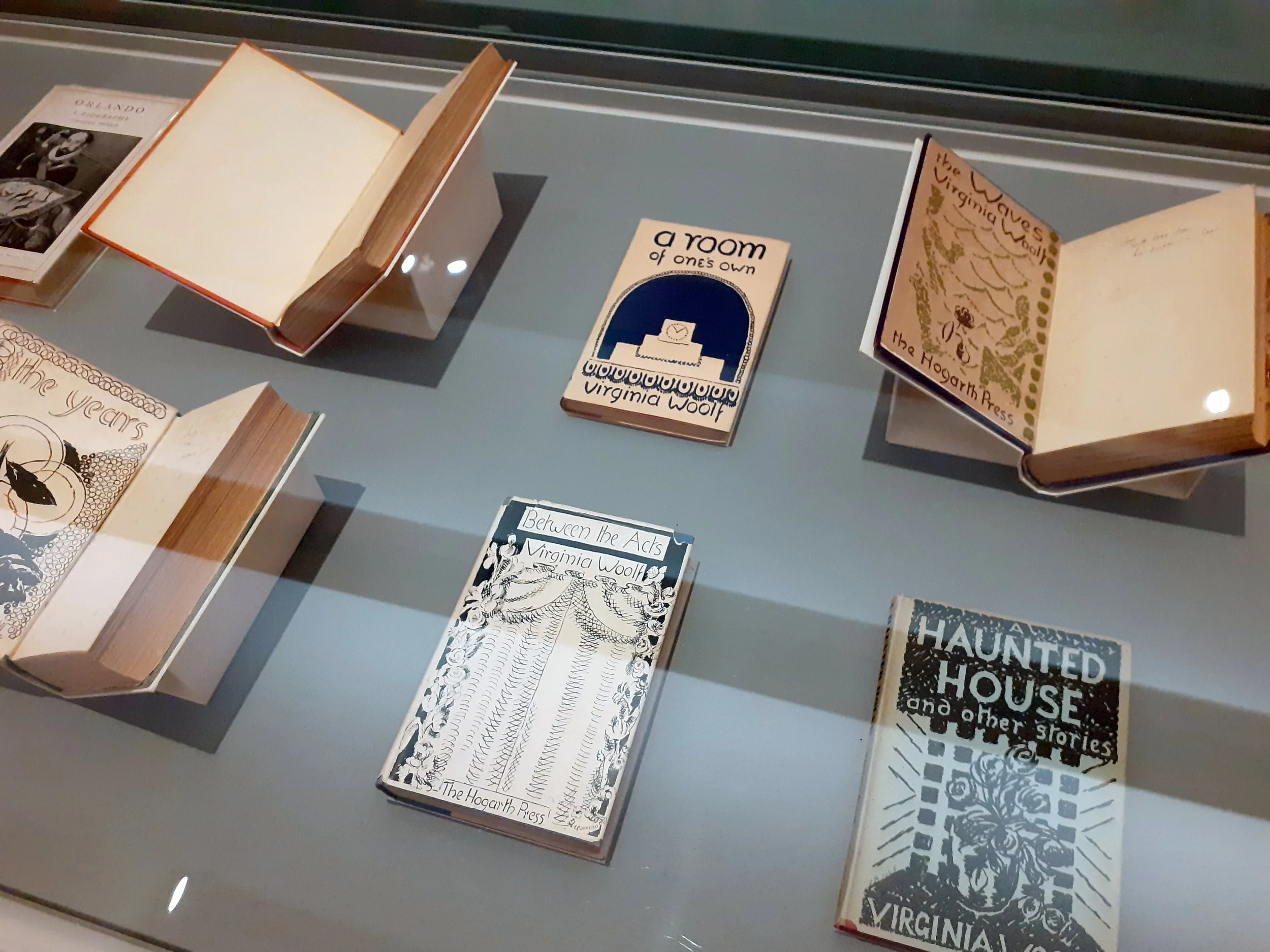
Virginia Woolf, “A Room of One’s Own” (1929). Photograph: Birgitta Huse
The Bloomsbury Group is a synonym for an avant-garde ‘causing-a-stir’ lifestyle, even more so when it comes to sexual relationships. Despite the fact that exhibition visitors expect this aspect to be presented in the show they might get to see more than they bargained for. A content guidance on the exhibition entrance door proclaims that this exhibition “contains one room with sexually explicit content.” In a somewhat hidden, smaller room, which is not instantly identifiable as the zone one has been warned about beforehand, a collection of intimate paintings and drawings by Grant is awaiting their onlookers. The inclusion of an entire range of these works in the exhibition is questionable, as these erotic drawings were not originally intended for public display. A text in the room explains that “Duncan gave them to his friend Edward Le Bas for safekeeping, marked with a note: “These drawings are very private.” At the same time the note from 1959, which is available on the Charleston House homepage, states that Grant wanted Le Bas “to do what he likes with them.” The collection remained in private hands. Prior to the Coronavirus pandemic, the collection’s owner Norman Coates started to discuss its return to Grant’s home and studio in order to support Charleston’s survival. Coates wanted the drawings to be shared with Charleston visitors - in accordance with Grant’s permission. For more information and some of the images visit https://www.charleston.org.uk/stories/extraordinary-gift-of-duncan-grants-private-drawings-given-to-charleston/ [accessed on 12.11.2026].
Bell and Grant moved to Charleston, a sixteenth-century farmhouse in East Sussex, in 1916. Grant was able to carry out agricultural work instead of military service during the first world war, daughter Angelica was born in 1918, and over the years the artists turned Charleston into a “living artwork.” It was in Charleston where Bell and Grant were able to celebrate family life and put their ideas into undisturbed practice together with other Bloomsbury Group members at the same time.
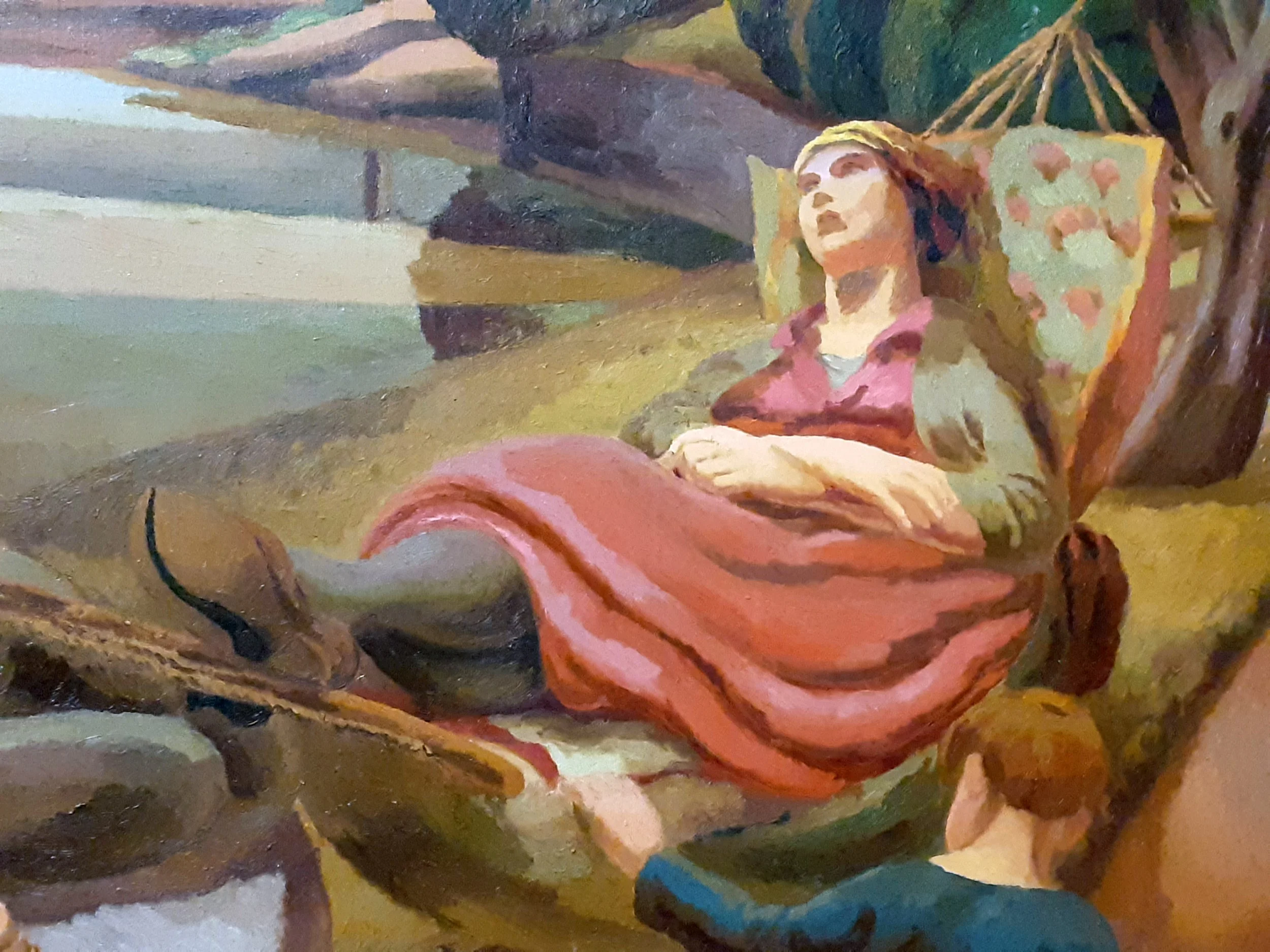
Detail of Duncan Grant, “The Hammock, Charleston” (1921-23). Photograph: Birgitta Huse
Whereas Brandon Camp in Norfolk, a tent village, served as an extraordinary and much-photographed and painted outdoor (holiday) destination in 1913, the terrace of Charleston assumed its place from 1916 onwards. After the first World War, Bell and Grant travelled in Europe, Southern France (St Tropez, Cassis), Italy and Spain, and they went to Paris regularly. By that time both were recognised by critics and art collectors as some of the leading painters of the day.
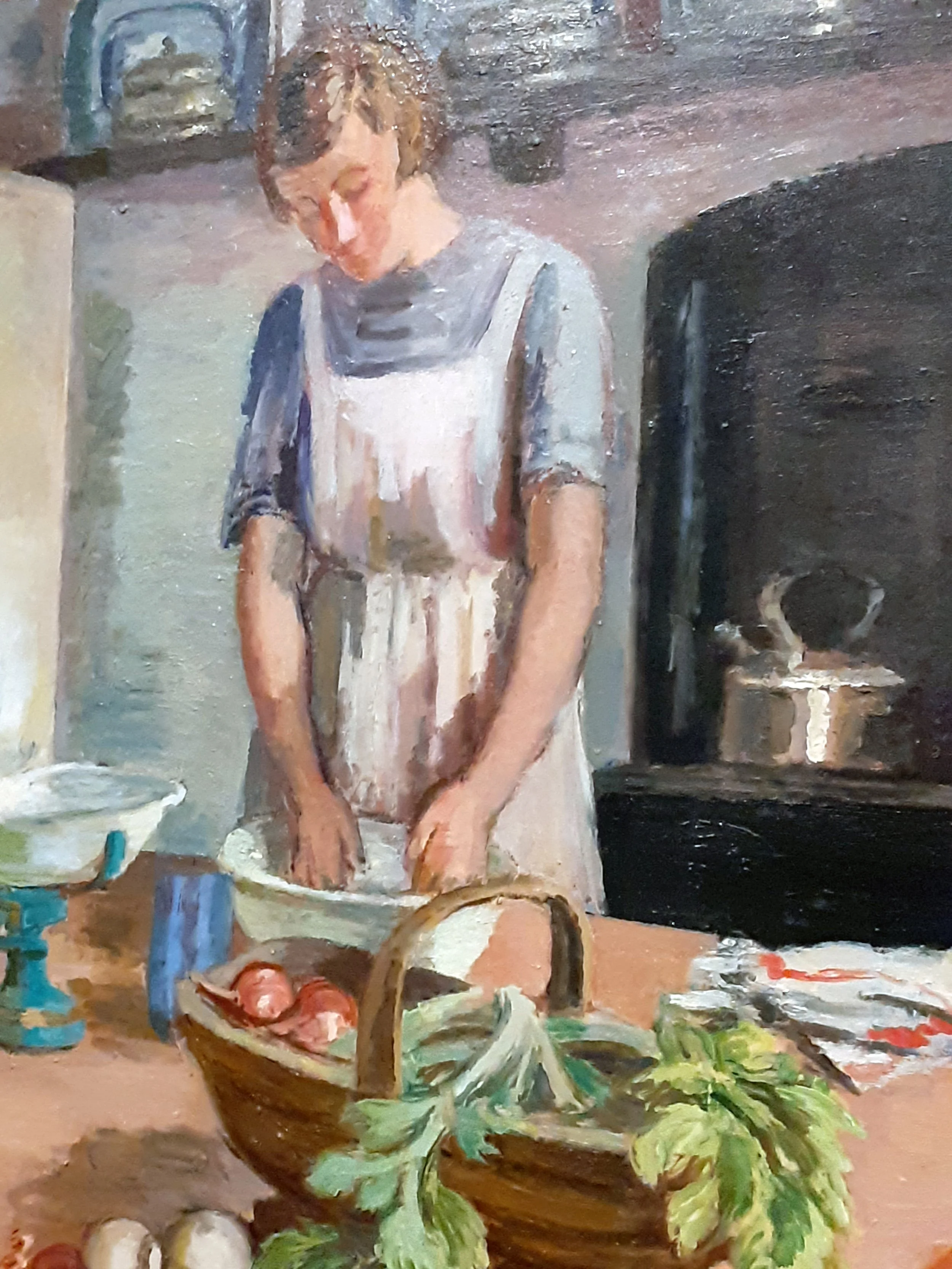
Detail of Vanessa Bell, “The Kitchen at Charleston, East Sussex” (c. 1943). Photograph: Birgitta Huse
Who did the cleaning and cooking while Bell and the others “did the living”? In her early sixties, Bell depicts Grace Higgens, the “Angel of Charleston” as she was called, in the painting “The Kitchen at Charleston, East Sussex” (c. 1943). I wonder why the painting’s title does not include the name of its sole human protagonist – but at least one of the people whose work enabled the artists’ experimental, privileged lifestyle can now be seen in an artwork, and potentially reminds exhibitiongoers of an often underestimated and even forgotten context of economic power and relationships.
The final highlight of the home story is the restaging of the Charleston studio, a “once-in-a-lifetime” experience says Tate. Bell’s and Grant’s studio moved from Charleston to London. Easel, brushes, paintings, notes, drawings, photos, ceramic, lampshades, chairs, cushions, textiles, fireplace, carpets, mirror, sculpture, a telephone and much more are restaged as an ensemble in a built room at Tate Britain. This move is made possible due to Charlston being under restauration. Bell’s and Grant’s studio thus found an interim location. The final highlight of the “Vanessa Bell and Duncan Grant. Inside Bloomsbury” home story tempts to touch and engage with the original objects within the studio like when playing with a dolls house, or to at least take a seat in front of the fireplace.
And - here he is again! Nearly overlooked amongst other studio (wall)decoration around the bust of Virginia Woolf on a chest of drawers, Duncan Grant looks at us with his blue eyes and turban. We come full circle, but differently to his “Turban appearance” in the first exhibition room it is only Grant’s head that we see now – no audacious theatrical pose and no naked body. Does this smaller self-portrait represent a certain change of the artist sitter’s attitude and behaviour over time in connection with changed circumstances? The self-portrait and its unspectacular place amongst many other objects within the restaged studio is an opportunity for exhibition visitors to reflect on how ‘everyday madness’ also affects artists with an unconventional lifestyle. The portrait which lacks any theatrical pose seems to show that Grant was not completely irrefutable by at least partially strenuous responsibilities like making a living, children, (sexual)relationships, and last but not least, ageing.
Altogether the show fuels the wish to get to know even more about its protagonists, their works as well as the time and places they lived in. The exhibition is thought-provoking in the sense that it causes critical questions, not only regarding society in the early twentieth century but also with reference to the society we live in today. Which contemporary lifestyle is causing a stir, and which is considered avant-garde? What do people experience who (want to) live an unconventional, alternative lifestyle? Who can afford staff and can thus afford indulging in “important things” – and how are these defined?
Vanessa Bell & Duncan Grant are on view from 12 November 2026 until 11 April 2027 at Tate Britain, London, UK. A hardback and a paperback exhibition catalogue are available.