
Anish Kapoor. All of Nothing. 2026. Photo: Birgitta Huse
“Kapoor takes us on an exhilarating perceptual journey that plumbs existential questions.”
“A bad poem is one that falls into meaning.”
Anish Kapoor
At Hayward Gallery.
★★★★★
WRITTEN BY DR BIRGITTA HUSE, 06.07.2026
“See what happens! ... Your own self will disappear!” – the enthusiasm with which a primary school-aged boy exclaimed this in the Anish Kapoor Exhibition at Hayward Gallery was shared by children, teenagers, younger adults and older visitors throughout the exhibition. Who wouldn’t feel inspired to start moving intentionally when realising that one’s own image changes while looking at Kapoor’s artworks?
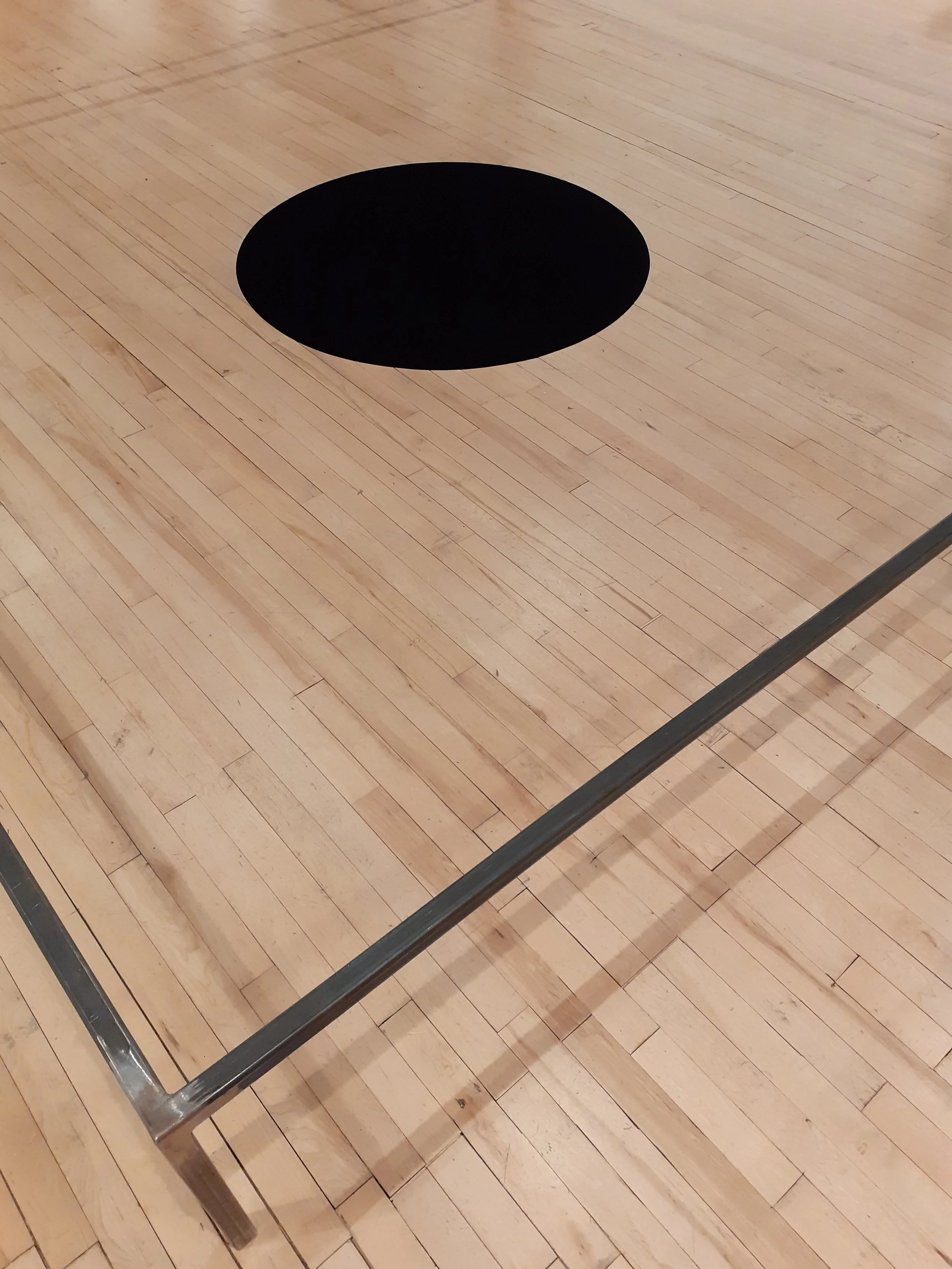
Anish Kapoor. Descent into Limbo. 1992. Photo: Birgitta Huse
The exhibition of works by Anish Kapoor (born in 1954 in Mumbai, India) “spans new and seminal works, offering a series of spectacular encounters” according to the Hayward Gallery. Visitors can also wonder about the black hole “Descent into Limbo” (1992) with which the Indian-born and London-based artist challenged a visitor of the Documenta show in Kassel, Germany, to throw his glasses into it. The visitor was upset that he had queued around forty-five minutes to supposedly just see a black round carpet on the floor. When his glasses simply disappeared after he accepted the provocation, the visitor stepped back and held onto the wall, Kapoor recalls when speaking about the incident. “The sublime is terrifying;” Kapoor refers to philosopher Immanuel Kant (1724–1804, Königsberg, Prussia) when saying that this would be his purpose as an artist. In London the “Descent into Limbo” is one of a series of works which the artist made using Vantablack, the “black’s black”. Vantablack is a light-absorbing nanotechnology so black it makes three-dimensional forms appear entirely flat when seen head-on. Kapoor secured an exclusive licence to use a Vantablack variant for artistic use in collaboration with the UK-based technology company Surrey NanoSystems, a fact that caused controversy.
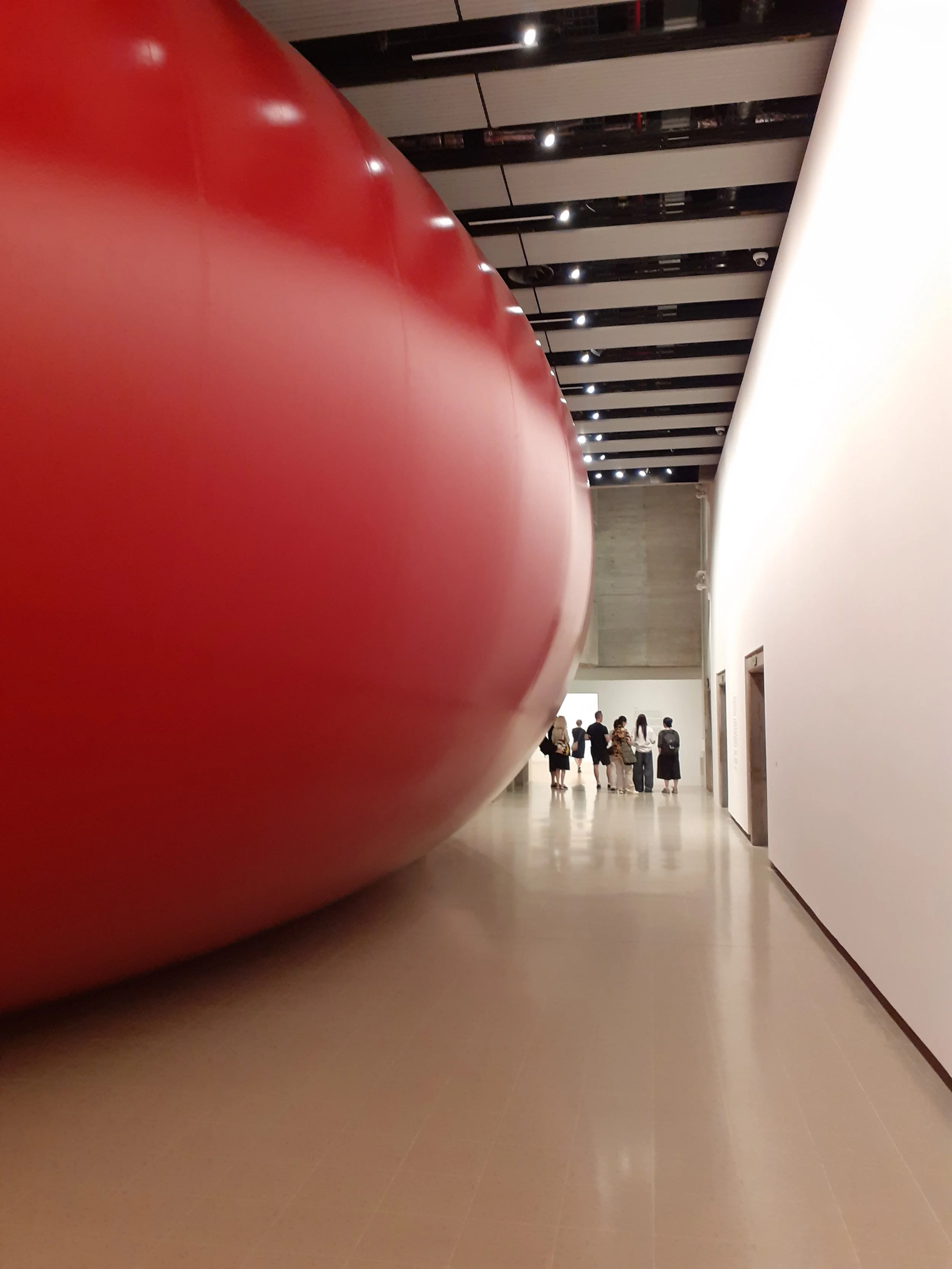
Another encounter with Kapoor's work awaits in what I would call the "red room". The massive and predominantly red sculpture “Mount Moriah at the Gate of the Ghetto” (2022) expands from the ceiling and takes over the room. It is explained that the work “refers to Mount Moriah, which in the Old Testament is described as the place where God commanded Abraham to sacrifice his son Isaac.” The work invites visitors to walk underneath and around its lowest part. In my case, it sparked memories of visits in limestone caves with stalactites as well as my experiences of standing under a boat hull. There are countless other possible memories, feelings and associations. Kapoor is successful in inspiring people to explore and to speak with others about the artworks, about the discoveries made and about associations and thoughts which potentially interrupt our everyday routines and assumptions.

Anish Kapoor. Mount Moriah at the Gate of the Ghetto. 2022. Photo: Birgitta Huse
Size, materiality and colour play an important part in Kapoor’s art. The artist himself proclaims that he is obsessed with red. “Ha Makom” (2026) is an entirely red sculpture which occupies a whole gallery room. “Ha Makom” translates to "the place" in Hebrew and is a name for “God” in Jewish tradition. Kapoor repeatedly stresses that everyone should feel free to experience his works in different ways and draw different conclusions. I do not wish to withhold the associations I had prior to reading the work’s title and familiarising myself with more information about it: The artwork reminded me of the Grade II-listed Cliftonville Lido at Margate beach with its rocks and unused buildings. The work not only entices visitors to touch it but even to climb onto it – as a female exhibition visitor expressed when commenting “I do want to jump on it!”. Kapoor’s art offers itself for varied interpretations depending on how the works are approached. Do you usually read the title and explanation before immersing yourself in the artwork itself, or do you often proceed the other way round?
An untitled round stainless-steel sculpture from 2026 on the wall in one of the exhibition spaces that follow provides a kind of outlet for the built-up need for action as a result of walking around “Ha Makom” yet not allowed to touch the structured surface or to climb onto it. It was not only the primary-school boy at the start of my text who could not contain himself posing in front of the steel sculpture on the wall: young couples, a group of young men, two elderly ladies as well as families also took the time to experiment together, moving their arms, bending down and changing their distance from the artwork, and to share their impressions with each other.
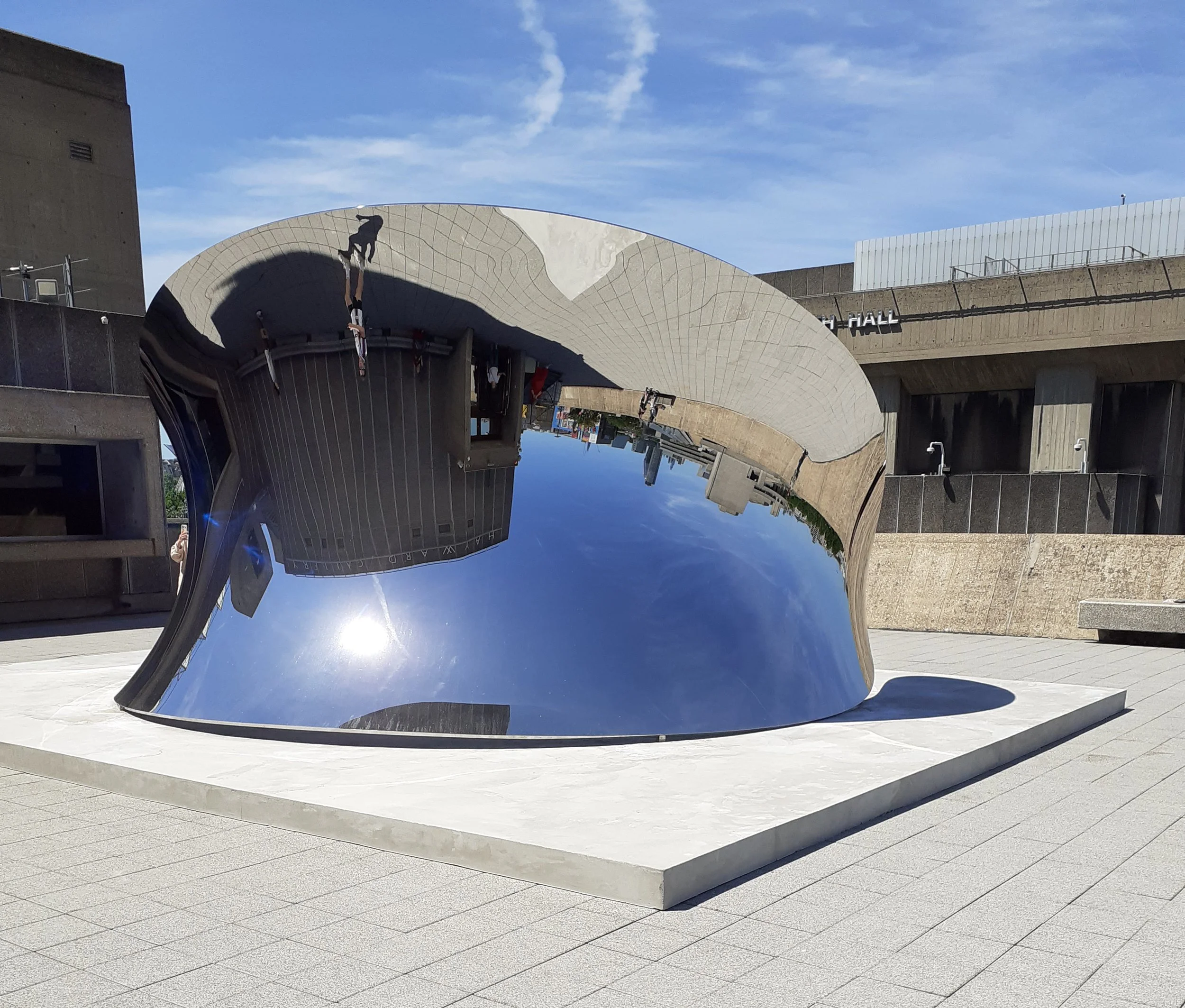
Anish Kapoor. Tsunami. 2025. Photo: Birgitta Huse
Kapoor’s stainless-steel sculpture titled “Tsunami” (2025) displayed on the terrace outside adds to these multilayered encounters. Each step around the sculpture changes what is seen and how: oneself, other people, the nearby brutalist buildings and the sky, for example. Another possibly unsettling discovery follows when leaving this roof terrace. The outside and inside spaces blend in the sense that whatever happens on the terrace outside is visible through a window from the inside, whereas one cannot look inside from the outside due to the way the one-way mirror window is positioned. As with other reflective surfaces in the show visitors take selfies here, but here this may be done without awareness of who might be watching.
“Kapoor takes us on an exhilarating perceptual journey that plumbs existential questions” says Curator and Hayward’s departing Director Ralph Rugoff about the show that coincides with the Southbank Centre's 75th anniversary.
Kapoor’s turning the world and our perception of it upside down and inside out results in a feeling of insecurity which might not be comfortable for everyone. To notice and accept a certain degree of uncertainty and to realise that one is not alone with it are emotional responses that are not only key in connection with this Kapoor show. Insecurity can have a positive effect as it leads to questioning, new thinking and movement. One of the exhibition’s accompanying events is a conversation between Kapoor and author and psychoanalyst Darian Leader to explore the psychological, spatial and philosophical dimensions of Kapoor’s practice. The artist thus further stresses the relevance of psychological and philosophical dimensions in art and the engagement with the psyche more generally as clearly relevant for contemporary society. On receiving the Wilhelm Lehmbruck Prize of the City of Duisburg and the Landschaftsverband Rheinland in Germany in April 2026 Kapoor cites his favourite quotation by the French poet Paul Valéry (1871–1945): “A bad poem is one that falls into meaning.” Kapoor concludes as follows with reference to his conception of the role of an artist: “Therefore it must follow that a good poem is one which sits between meaning and no meaning. Leaving space […] for the viewer. […] I feel that is the true role of the artist, to sit in this in between space where uncertainty gives fruit.”
For those who like being challenged in their perceptions and thoughts, Kapoor’s Southbank Centre exhibition is a fascinating experience. Not just the multi-reflective sculptures alone, but also the artworks with Vantablack invite communication with others, including strangers. "See?! I told you." This comment by the primary-school boy quoted earlier, worked as a reminder and a plea for me to recognise the ongoing importance of listening to each other attentively and to speak with each other independently of differences in experiences and horizons due to age and ancestry, for example.
The show is an excellent testing ground for photography. I have never seen nearly everyone in an exhibition take as many pictures of artworks from a range of angles. The well-known "selfie addiction" elicited by reflective surfaces constitutes one specific type of engagement – surprisingly, other visitors are often part of these images taken. In the stainless-steel pieces, we see ourselves and we see others together with us from the position of an observer. I felt as though the red dress I was wearing on the day of my visit encouraged strangers to start conversations with me. The same may well be true for other visitors wearing colourful or otherwise distinctive clothing.
Unsurprisingly, Kapoor is one of the most significant contemporary artists. With his works he attracts a broad and diverse audience interested in art without being superficial. It is impossible to withdraw from experimenting with one’s senses when being confronted with his artworks. Surprise and loss of control are intended. In the London show the last three sculptures displayed alongside six paintings, however, are somewhat less spectacular in comparison to the preceding works. At least during my visit, the final exhibition room did not attract the same level of attention from visitors as the rooms before.
The exhibition exit is right next to the entrance. In this way, the visitor's return to the starting point provokes a “before” and “after” reflection on the visit, even more so as one meets the faces of surprised others who have yet to start their tour. The comments I heard undoubtedly speak about an irritating but also fun and thought-provoking experience, and a feeling of enrichment. Last but not least, the fact that one does not automatically enter the shop via the exhibition exit leaves a moment for taking a deep breath without immediate overstimulation.
“Anish Kapoor” can be seen at Hayward Gallery, Southbank Centre, London, UK, until 18 October 2026. Also see the exhibition with Kapoor’s works at Lehmbruck Museum, Duisburg, Germany, showing until 18 October 2026.