
Frida: The Making of an Icon
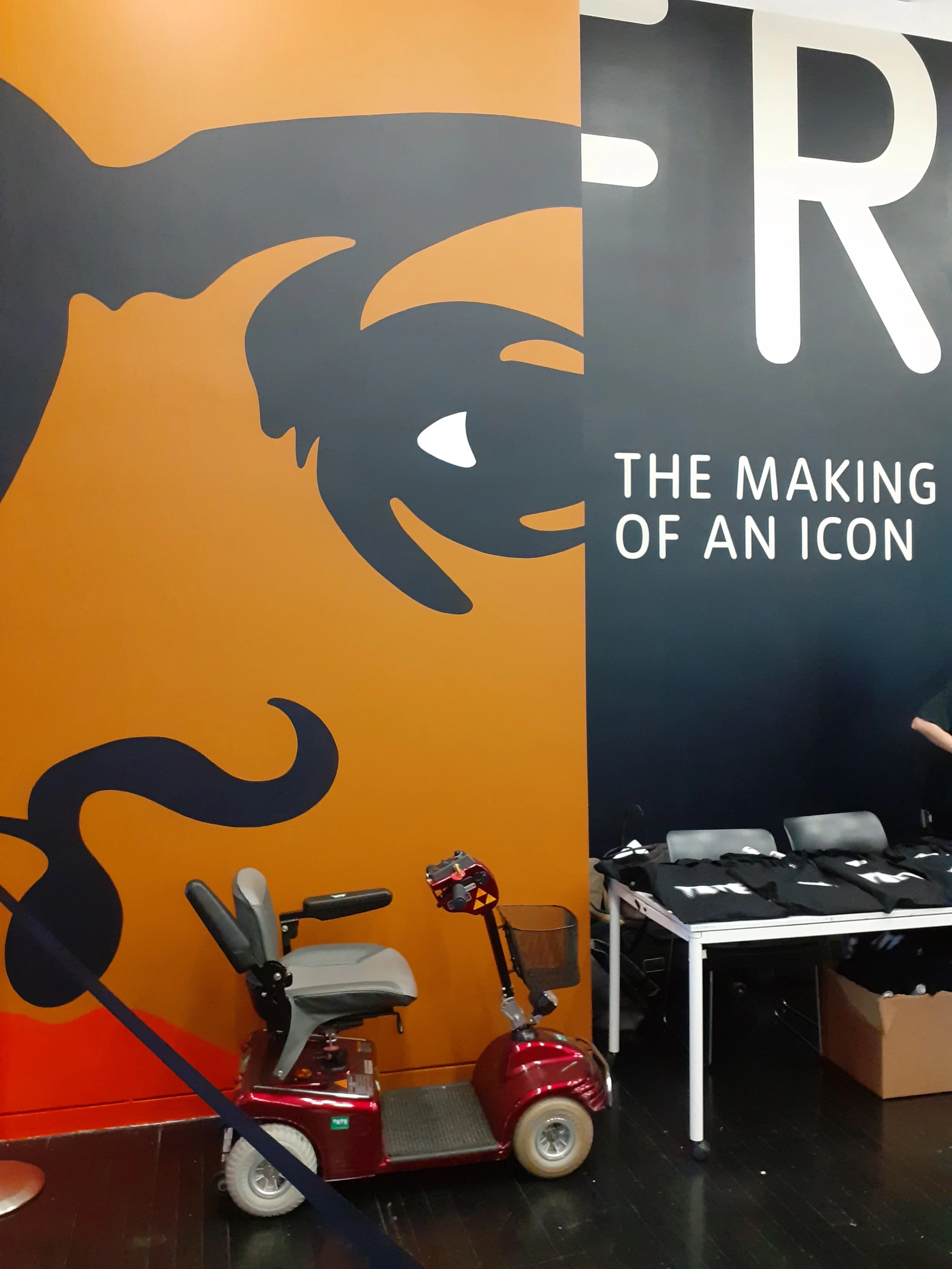
Exhibition entrance. Photo: Birgitta Huse
“Kahlo’s works, not only paintings on canvas but also paintings combined with objects from Mexican popular culture like a tin butterfly for example, are placed into dialogue with the works of other artists.”
“The exhibition has already become the highest pre-selling show in Tate’s history with more than 35.000 tickets already sold.”
Frida: The Making of an Icon
At Tate Modern.
★★★★★
WRITTEN BY DR BIRGITTA HUSE, 24.06.2026
Reaching the top of the moving staircase at Tate Modern and looking forward to the press view I spotted an electric mobility scooter in front of the exhibition entrance. How would Frida Kahlo have transformed a scooter like this one to her taste and style? What would she have painted on it? Perhaps she would have sprayed a graffiti onto it?
How Frida Kahlo’s (1907 - 1954) medical aids of the time looked like is to be seen in the centre of the first exhibition room. Her body cast which she painted with a red hammer and sickle is an eye catcher in the room with walls painted in a stimulating, blood-like red colour. A part of the material presented here deals with Kahlo’s accident as the life-changing event she and those around her had to cope with somehow.
One of the first two black and white photos at the exhibition entrance shows Frida in 1926 in one of her father’s suits together with family members. She clearly stood out. Just imagine how it must have been for Frida as a child and teenager to be frequently photographed by her German-born father, an extraordinary and acclaimed photographer, Guillermo Kahlo (originally Carl Wilhelm Kahlo from Pforzheim, 1871 – 1941). She was familiar with her father’s photographic practice and, given the fact that her grandfather, the father of her mother Matilde Calderón y González (1874 – 1932), was also a photographer, Frida very likely learned about the potential impact of photos and portraits at quite an early age. Seen from a more practical perspective, Guillermo Kahlo’s suit covered Frida’s hips and legs only a few months after the accident she had that left her spine heavily damaged, just as the skirts and huipiles (Mexican blouses) from her mother’s home state of Oaxaca did later on.
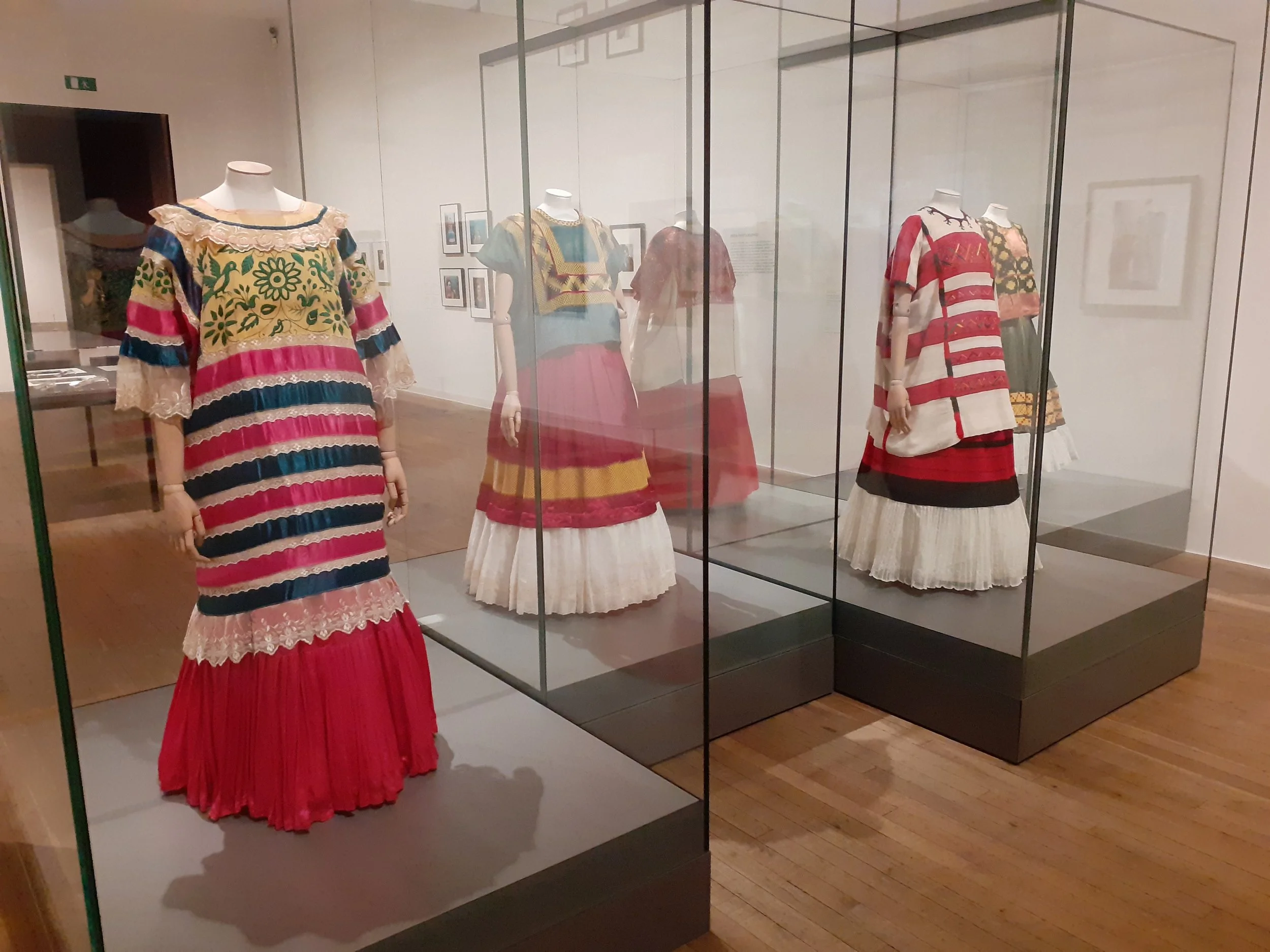
Garments from Frida Kahlo. Photo: Birgitta Huse
Several examples of the traditional Oaxacan dress of the time from Kahlo’s wardrobe presented in big showcases form a kind of transparent barrier in the second exhibition room – a barrier that, once passed by, reveals the focus and theme of the exhibition: “Frida: The Making of an Icon”. Kahlo’s works, not only paintings on canvas but also paintings combined with objects from Mexican popular culture like a tin butterfly for example, are placed into dialogue with the works of other artists. Some of them were Kahlo’s contemporaries. Many of them are artists who are our contemporaries today. Altogether, the works of eighty-six artists are exhibited.
“Tate Modern opens the first major exhibition to explore how Frida Kahlo (1907 – 1954) became a global icon…this landmark show examines how Kahlo’s art and life inspired generations of artists across diverse media, movements and communities around the world,” Tate Modern proclaims. Over thirty works by Kahlo alongside photographs and personal artefacts are presented in the show that is organised by the Museum of Fine Arts, Houston, in collaboration with Tate Modern, and in partnership with Lead Global Supporter, Bank of America.
Just as in Kahlo’s works, Mexican folk culture, questions of identity and a critical perspective onto significant societal circumstances and discussions are centre stage in artists’ works who got inspired by Kahlo’s art. The following are only some examples of the many attractive and thought-provoking works.
Olga Costa (1913 – 1993, born Germany, worked in Mexico) for example wears a worker’s blouse and sits in a traditional Mexican chair known as an equipal in her 1947 self-portrait. María Izquierdo (1902 – 1955, born and worked in Mexico) “draped herself with rebozos, traditional Mexican shawls. Like Kahlo, she tied her braids with yarn, but she generally resisted wearing indigenous clothing.” says an explanation near the 1946 self portrait of the artist.
“Kahlo’s self-portraits did not emerge in a vacuum.” Her contemporaries Abraham Ángel (1905-1924) and Manuel Rodríguez Lozano (1912-2017) had a romantic relationship and they explored new expressions of identity in their self-portraits.
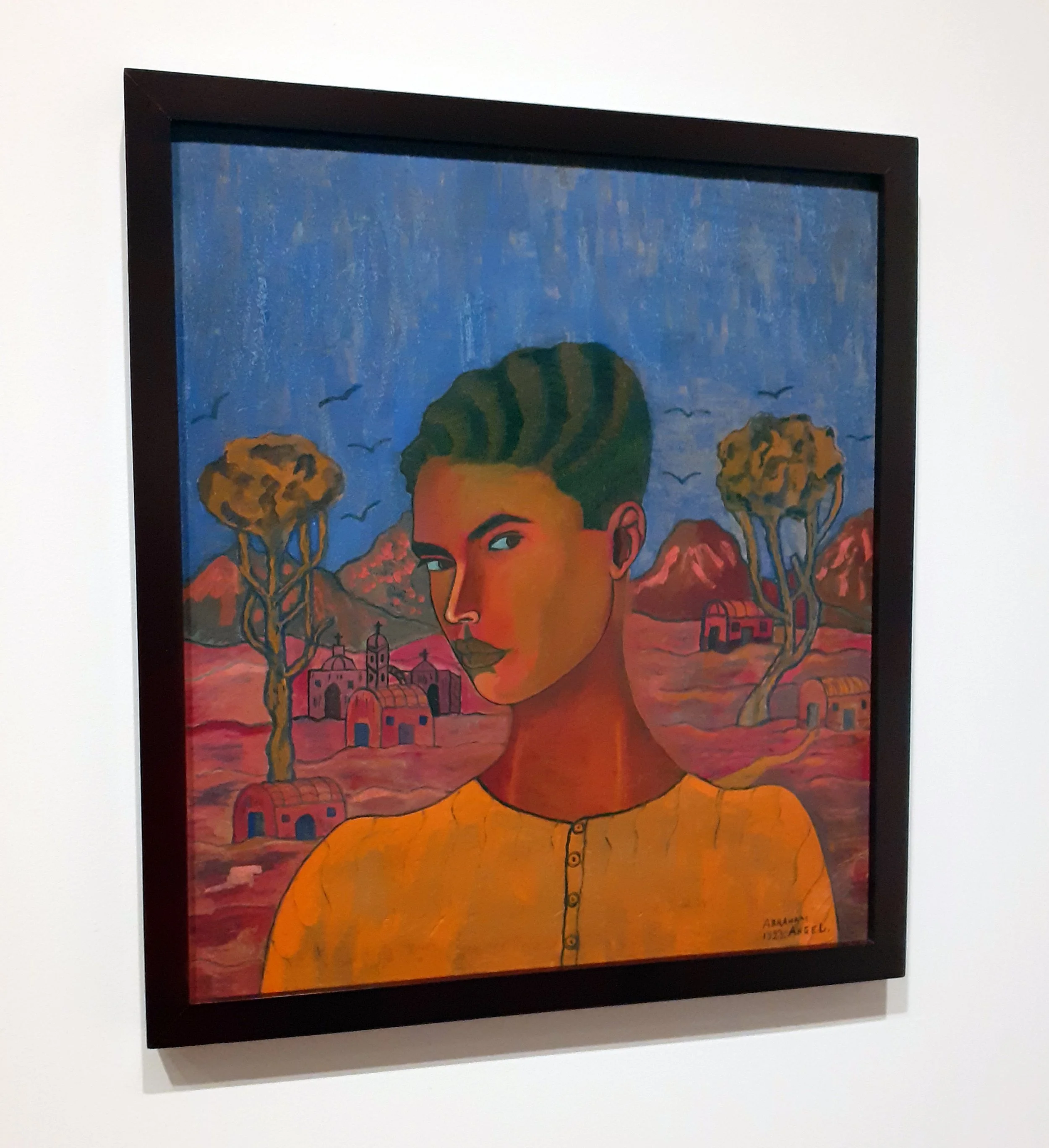
Abraham Ángel. Self-Portrait. 1923. Photo: Birgitta Huse
Santa Barraza (1951, born and works USA) explores her identity as a Chicana artist and draws “inspiration directly from Kahlo’s style and motifs” is explained. In the 1992 painting “Homage to my Mother Frances” the artist “represents her family lineage using a pictorial dating system developed by the Aztecs” and portrays her family members around a central figure that emerges from an agave plant.
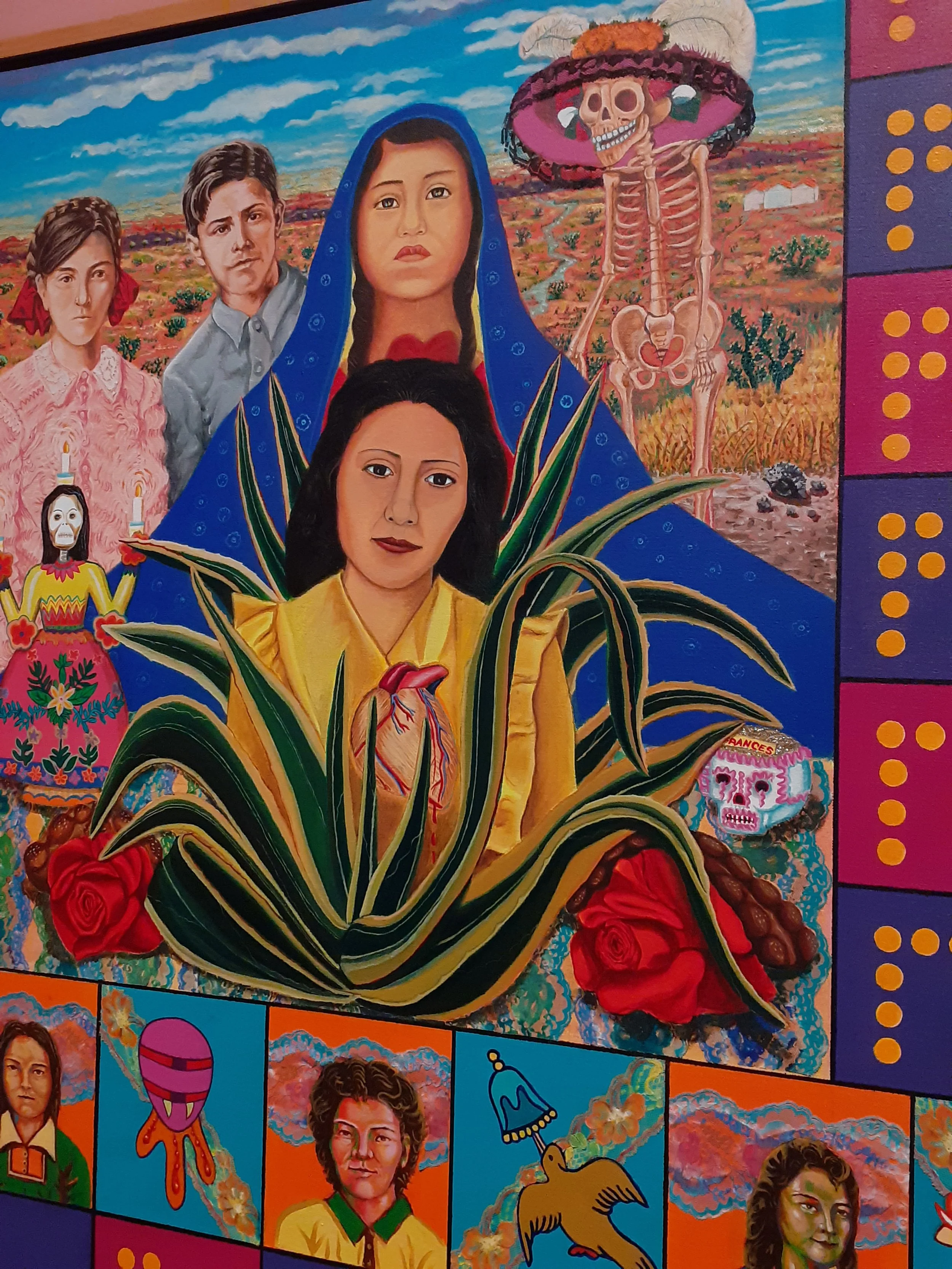
Santa Barraza. Homage to my Mother Frances. 1992. (Detail) Photo: Birgita Huse

Julio Galán. „Si y no” (Yes and no). 1990. (Detail) Photo Birgitta Huse
Julio Galán’s (1958 – 2006) work „Si y no” (Yes and no) from 1990 in the last exhibition room dedicated to paintings and other artworks is an example of the late 1980s and 1990s “new generation of artists in Mexico (who) loosely grouped under the name “neo-mexicanism”. We read that they “responded to Kahlo’s breaking up of her identity into many different selves” and that “like her they reused images of Mexico’s religious celebrations, popular traditions and handcrafts. At the same time, they questioned fixed gender roles and stereotypical notions of Mexican identity. Rather than glorifying the past, they drew from these Mexican themes to create critical readings of the present”.
If you are not shy of being confronted with bodily and emotional experiences, such as engaging with the depiction of the act of giving birth, do not miss out on a small and rather hidden room as part of your exhibition parcour. Here we find Judy Chicago’s (1939) piece “Birth Tear Embroidery 3” from 1984. With this work Chicago, “a key figure in the US feminist art movement since the 1970s”, resonates with Kahlo’s “Frida and the Miscarriage”.
The exhibition ends with merchandise objects and books about Frida Kahlo which in one case were translated into over twenty-five languages. The outstanding features of Kahlo’s appearance are reason enough for easy recognition: Her eyebrows, her Oaxacan attire and her black pleated hair including flower adornment. And finally - the “making of an icon” goes on. Who wouldn’t like to own a useful piece with Frida on it? Stepping out of the exhibition into the exhibition shop the quantity of catalogues, books and further exhibition merchandise like earrings, bags, prints and more invite a purchase, and thus promoting Frida’s image further.
This exhibition is not to be missed by those whose interest goes further than seeing some of Kahlo’s very well-known paintings and some of her original corsets and garments. I personally have been able to discover some of Kahlo’s works that I had not known about before. This Tate show is an opportunity to see many contemporary artists’ works placed in dialogue with Kahlo’s works, which makes for the main attraction and relevance of this show.
If you feel inspired you can delve further into the “London Fridamania” with special events, public art (six large-scale murals around Bankside) and chef Santiago Lastra’s “bespoke menu inspired by Frida” at Tate Modern Restaurant in order to “experience the exhibition through art and food”. “The exhibition has already become the highest pre-selling show in Tate’s history with more than 35.000 tickets already sold,” according to Tate.
Frida: The Making of an Icon is showing at Tate Modern, 25 June 2026 until 3 January 2027.