
“Here she is!” : Ana Mendieta at Tate Modern
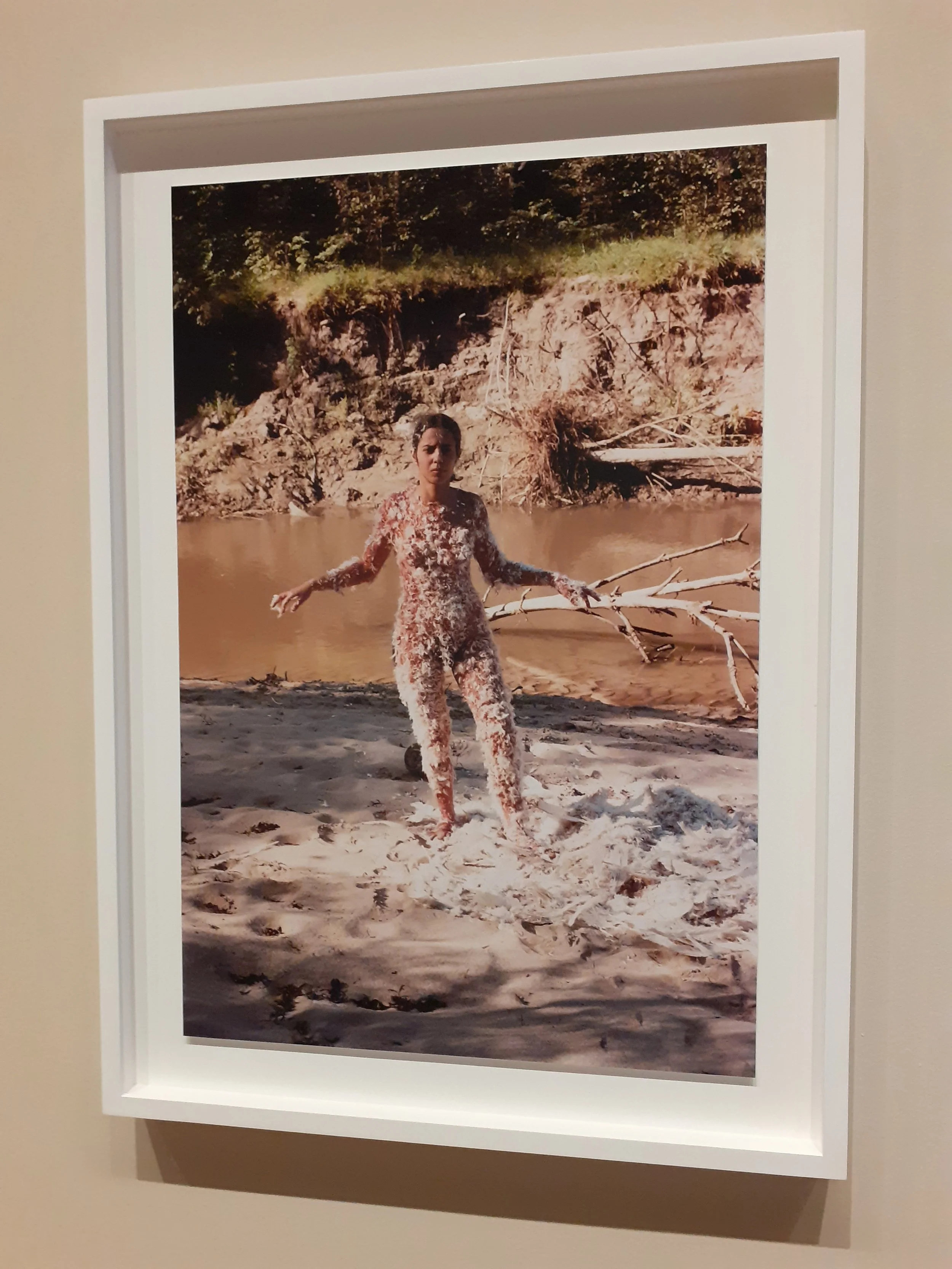
Ana Mendieta, Blood + Feathers, 1974. Photo: Birgitta Huse
“Mendieta expressed her critical thinking in the face of up-to-date events; in this case the violent sexual assault and murder of a fellow woman student at the University of Iowa – and her critique of a lack of response to the events by the community.”
“Here she is!” : Ana Mendieta
At Tate Modern.
★★★★★
WRITTEN BY DR. BIRGITTA HUSE, 07.07.2026
Ana Mendieta, the Cuban-US American artist (1948 Havana -1985 New York) is present. A photo shows her body covered with flowers in an ancient tomb. She speaks and moves her chin and jaw in a video. Mendieta plays with her own or someone else’s hair in a photo series. Standing in a river, she pours a liquid from a pot over her body. These are just some examples of her presence.
A small area with red walls in the middle of the exhibition seems to embody the “heart of the show”. Elements that connect to the core identity of the artist, and personal insights by Mendieta, are gathered here. A wooden mother-and-child sculpture references Cuban Catholicism in which Madonna and child are represented by the national saint Nuestra Señora de la Caridad del Cobre (Our Lady of Charity of El Cobre). The saint, in Cuban diaspora, “represents national solidarity and unity regardless of race, social class, and political and religious orientation” – we read near the sculpture. A painted self-portrait from c. 1970 is grouped with some photos of the artist’s 1972 hair sculpture experiments. In this room, we learn about Mendieta’s later confession in relation to her 1969 painting De película (“like a movie”): “she expressed that she wasn’t able to convey the power and magic that she had seen other artworks charged with, through painting. This prompted her to start working in other mediums.”
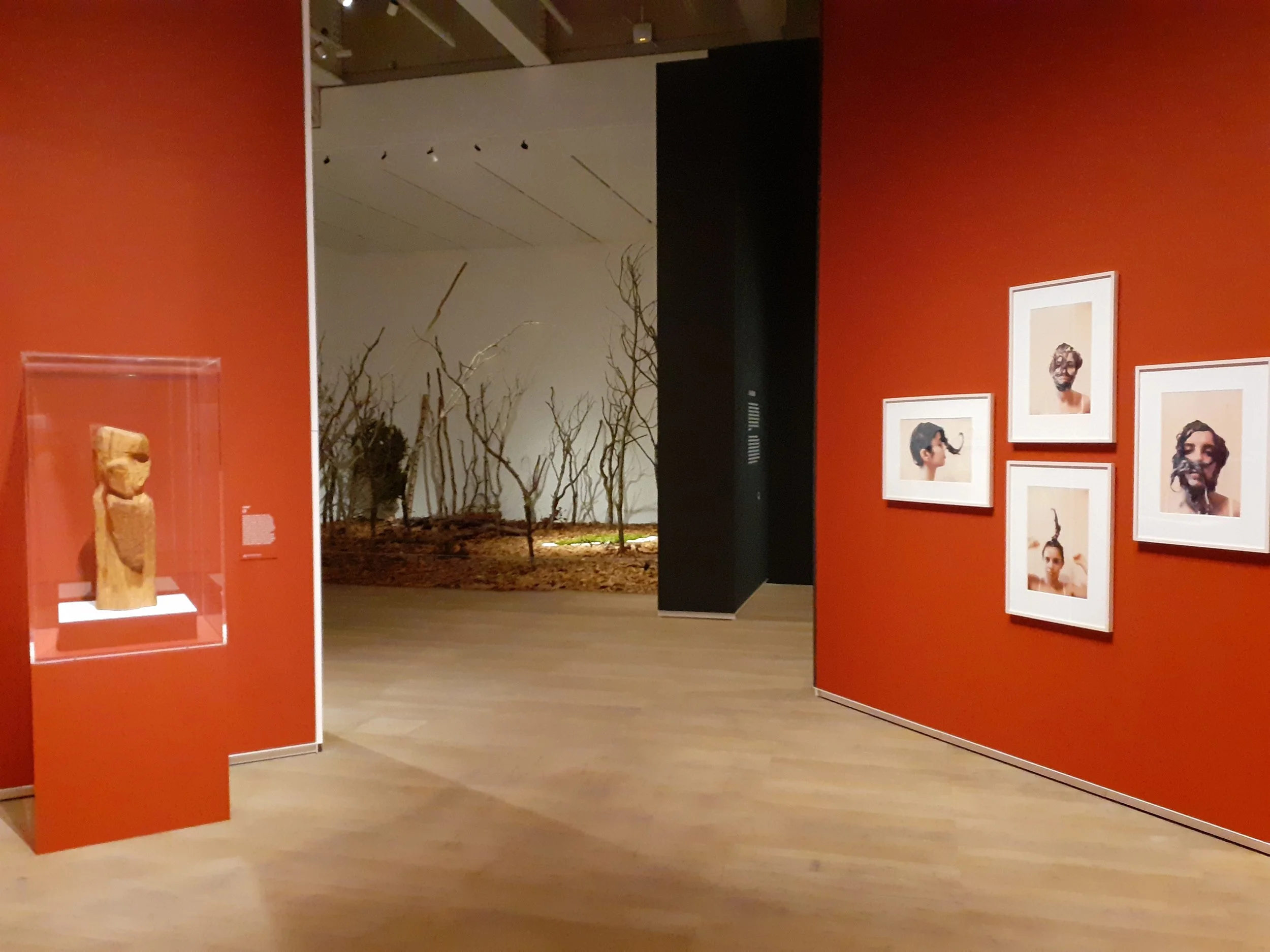
Exhibition view. Photo: Birgitta Huse
The red-walled area is surrounded by important parts of the artist’s body of work, each of which were close to Mendieta’s heart.
The area labelled “The School” is dedicated to Mendieta’s experimenting, questioning and pushing boundaries first as a student and later as a teacher, encouraging her students to do the same. Via an earphone the visitor can hear children describing what they think to be the soul – for example – and thus answering the corresponding question posed by Mendieta. At times this part of the artist’s life seems underestimated at best; critics have previously accused Mendieta of working as a school teacher only to make a living. Yet, the project’s results which are presented in this exhibition section prove how important the work with children was for Mendieta in terms of young people’s and her own (artistic) development. Indeed, what could possibly be negative about working with children who will build our future – and making one’s living all at once?
Mendieta’s experimental approach using technologies of the time materialises in her film “X-ray” from c. 1975. Employing cinefluorography, which captures motion within the human body, her cheekbones are seen moving and she is heard speaking accordingly.
“Moffitt Building Piece” consists of 15 photographs made in 1973 and document the artist’s observations of people’s reactions to a crime scene she had created outside a building in Iowa. Mendieta expressed her critical thinking in the face of up-to-date events; in this case the violent sexual assault and murder of a fellow woman student at the University of Iowa – and her critique of a lack of response to the events by the community. Mendieta’s artwork serves as a plea to overcome indifference in one’s everyday-life, and to take action.
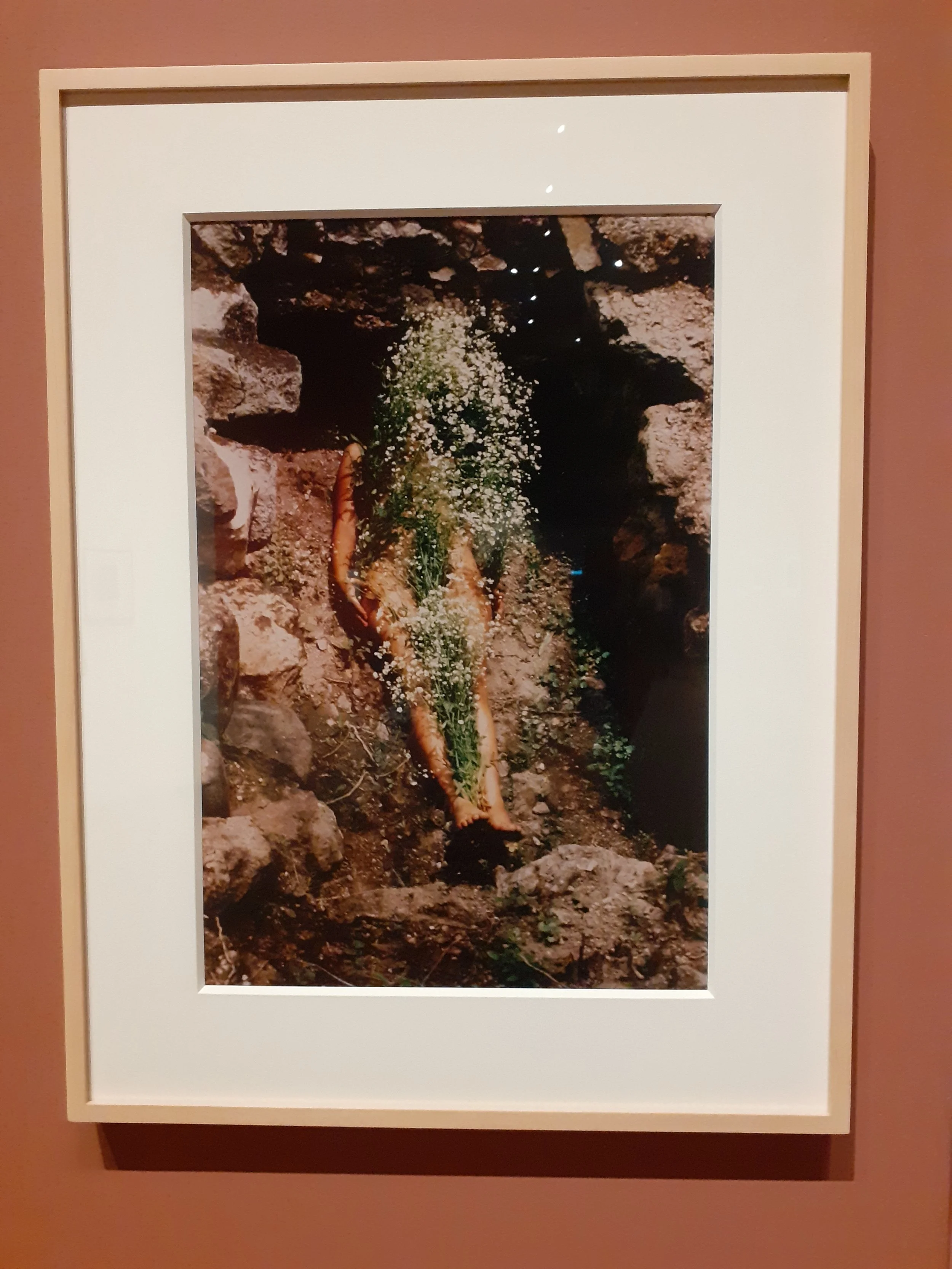
Ana Mendieta, Imágen de Yágul, 1973. Photo: Birgitta Huse

Exhibition entrance showing Anima, Silueta de Cohetes (Firework piece), 1976, by Ana Mendieta. Photo: Birgitta Huse
Entering another section of the exhibition, I witness Mendieta’s inspiration by Mexican culture. She regularly stayed in Mexico and repeatedly returned to the same places in the southern state of Oaxaca. Here, she started her series Silueta – her “earth-body” works: a blending of her body, materials and nature, in 1973. The first Silueta in the exhibition area called “The Repertoire” is the Imágen de Yágul. This Silueta which she created at the archaeological site of Yágul depicts Mendieta covered in weeds and flowers in an ancient open tomb, “covered by time and history” as she said. The artist regarded this to be her first Silueta in a series she worked on for more than a decade.
For Anima, Silueta de Cohetes (Firework piece), 1976, Mendieta hired an Oaxacan fireworks-maker. Fireworks were burnt on a wooden grid which traced the outline of her body. A special effect was caused by fireworks forming a heart inside the wooden construction - the last ones to expire. Mendieta’s inspiration by Mexican popular culture is strongly recognisable for someone who is familiar with Mexican culture. Her firework piece reminds of the Dance of the Torito (small bull). This dance is part of Mexican popular culture on festive days and especially important during carnival as a celebration and a reminder of renewal. For this, a man puts a makeshift stick bull with fireworks over his shoulders and then moves in a public space with the fireworks burning as the torito.
Another fascinating reference to Mexican popular culture is Mendieta’s use of brown and white bark paper, papel amate, for what she calls “amategrams” with black paint. In Mexican culture the use of papel amate as a material base for the codices and tax tributes dates back to pre-Hispanic times. The Otomí Indigenous people in the Mexican Sierra de Puebla use the papel amate as representations of deities and as a ritual element in healing ceremonies. For (Mexican) tourists multi coloured amate art and crafts works showing miniature scenes of everyday life are made by Otomí and Nahua Indigenous people since the 1950’s.
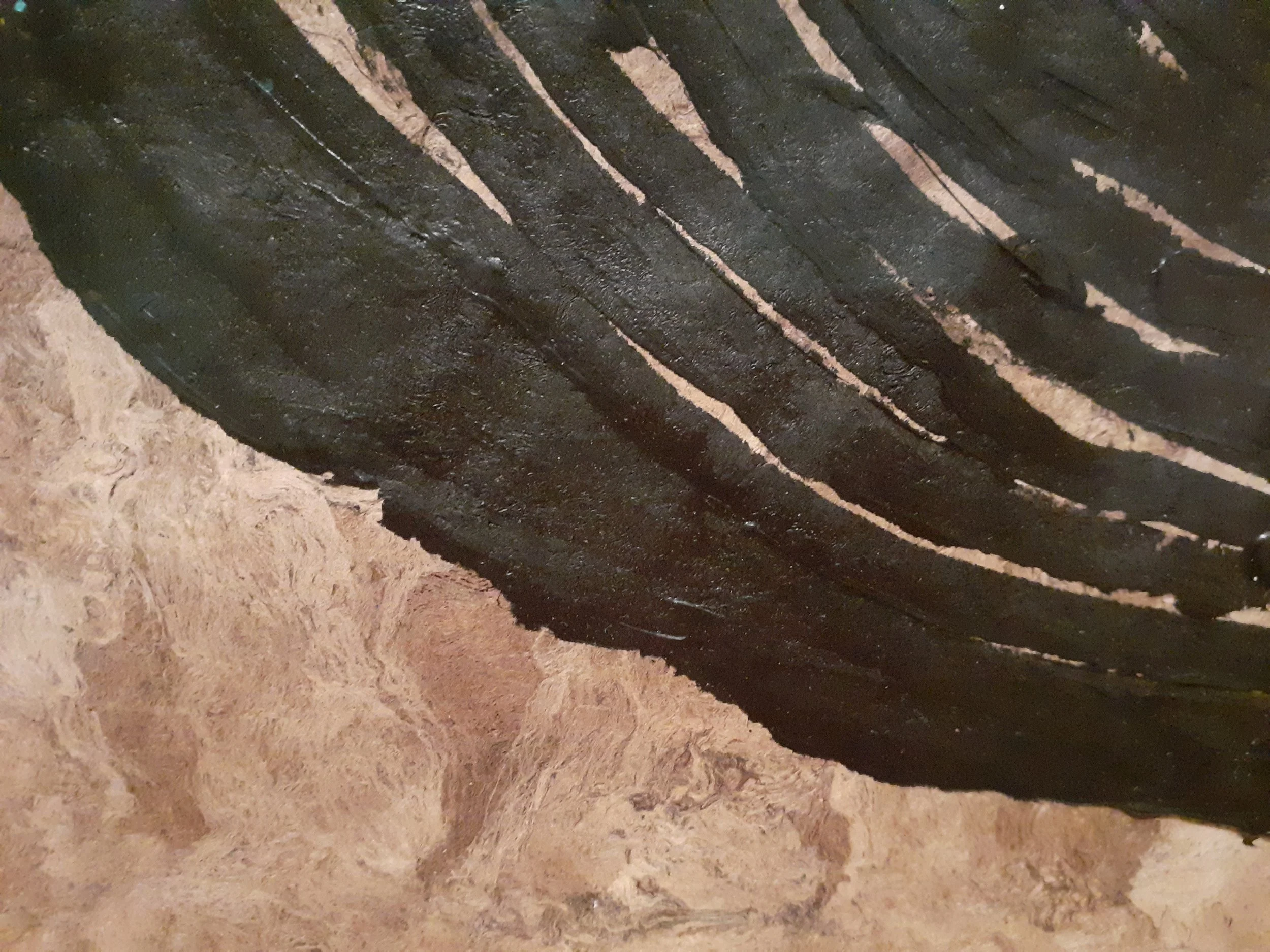
Ana Mendieta, El Laberinto de Venus, 1982; detail. Photo: Birgitta Huse
Mendieta studied archaeology and not only had an interest in Indigenous cultures but connected with Indigenous knowledge in her artistic practice. She compiled an index of Indigenous forms for her own use. Mendieta saw her work in the tradition of a Neolithic art, proclaiming: “‘I’m not interested in the formal qualities of my materials, but their emotional and sensual ones.” Her performances in a river are an example for this. The videos shown on several suspended screens in an otherwise dark showroom were remade for the first time especially for this exhibition. Water is key in rites de passage in many contexts worldwide, from Indigenous beliefs to Christian baptism. The exhibition curators hit the nail on the head by using Mendieta’s water-related videos in a dark room as a figuration of a rites de passage. This rite de passage is from Mendieta’s work shown up to that point of the exhibition, to entering the last exhibition section called “The Treshold”. Transformations of Mendieta’s body into the form of other beings and a transfer of energy between beings represent Mendieta’s belief in one universal energy that runs through everything. It takes centre stage in the last part of the exhibition.
In the exhibition section following Mendieta’s river videos her connection with the Afro-Cuban Santería tradition is demonstrated with her work titled Ñañigo Burial which consists of 47 black votive candles. Recreated for this exhibition the candles will be lit in accordance with the cycle of the moon and due amounting wax, visitors will be able to see a changing artwork depending on the month of their visit. Ephemerality and the factor of time are made tangible.
In 1974, Mendieta used the skin of a shepherd dog which a Mexican local resident kept in memory of the dog. In a photo and a film, she documented herself crawling on all fours wearing the skin. The connection between animals and humans is considered to be special: not only in Mexican cultural tradition, every human being is thought of as having an alter ego in the form of one individual animal, and the fate of both as being directly connected. The belief’s visual presentation is referred to as totemism in anthropology.
Mendieta’s inheritance is relevant today in the face of the consequences of our decades long disrupted relationship with nature in form of a worldwide ecological crisis, a growing struggle to secure water and food included. Mendieta stages the interconnectedness of human beings, animals, and plants. Sand, leaves, bark, feathers and more are the base for the works which are not made to last, and which are either restaged or documented via photography and film. The locations where Mendieta produced these moments in time like the La Ventosa shoreline in Mexican Oaxaca for her “Bird Run” are changing continuously.
The Tate Modern show sparks varied sensual impressions as well as critical thinking regarding women’s rights, art critique writing, political thinking, migration and identity to name a few. Paper documents in exhibition showcases broaden visitors’ understanding and put Mendieta’s pieces and performances into societal, art world and political context. Mendieta’s active engagement in fostering women’s rights is made visible. She co-curated an exhibition of Third World Women Artists in the A.I.R. Gallery in New York, the first-artist directed, not-for-profit gallery for women artists in the USA. Mendieta wrote about her work La Venus Negra, 1980, herself in Heresies: a feminist publication on art & politics in order to “resist its appropriation by second-wave feminists” and to emphasise cultural specificities that she considered crucial. Mendieta’s biography also adds to understanding her work. Firstly, she experienced a separation from her parents as these sent her away from Cuba to live in the USA. Secondly, Mendieta’s Cuban origins certainly caused repeated difficulties in times of an anti-Cuban and anti-communism general public opinion.
“Where is Ana Mendieta?” was the question activists asked when Tate Modern opened its Blavatnik wing in 2016 including art works from Mendieta’s late husband Carl Andre but excluding works from Mendieta. Andre’s role in Mendieta’s death in New York in 1985 causes controversy until today. The discussion about the (non)presence of female artists in collections, shows and the artworld more generally is ongoing. Art institutions regularly position themselves. In Tate’s 2026 book “Ana Mendieta” Tate Modern’s Interim Director Catherine Wood begins her foreword with: “Tate has an enduring relationship with the work of Ana Mendieta. The substantial body of her works we have collected since 2009 has had a transformative place in our collection displays, and it has long been a wish among our curatorial team to present a survey of her work at Tate Modern.” Xochitl Gonzalez’s book “Anita de Monte laughs last”, 2024, is a real find for those who want to read fiction which is based on the case of Ana Mendieta.
With this exhibition, the late Ana Mendieta celebrates her fulminant take-over of parts of Tate Modern in London. Cuban-US-American Mendieta shares space and time with Mexican Frida Kahlo of German descent, British Tracey Emin of Turkish Cypriote descent and dozens of artists who are inspired by Kahlo and her work. In the very last Mendieta exhibition piece, the film “Bird Run” from 1974 which was remastered for the exhibition and is displayed in the UK for the first time, the artist runs towards us. Mendieta and her works are everything but somehow hidden anymore. “Here she is!”
Ana Mendieta can be seen 15th July 2026 until 17th January 2027 at Tate Modern, London, UK.